
Buying Near Providence Station? The Train You Can Ride Today Matters More Than the One Being Designed
TL;DR
Does RIPTA's new Providence transit center change what homes near the train station are worth? No. RIPTA's board moved the project into design on August 20, 2026, but there is no construction cost, no contract and no start date, so homes near the station are still priced on the transit that exists today. What already moves buyers is the rail line itself, and a Providence median sale price roughly $278,000 below Boston's.
RIPTA authorized design work on a new Providence transit center next to Providence Station. Nothing is funded for construction, nothing is scheduled, and the finished design has to go back to the board before anyone breaks ground. Meanwhile the Providence median sale price is $581,365 against Boston's $859,431, and the commuter rail connection between them already runs. For a buyer, the existing train is the story. The transit center is a footnote you should not pay extra for.
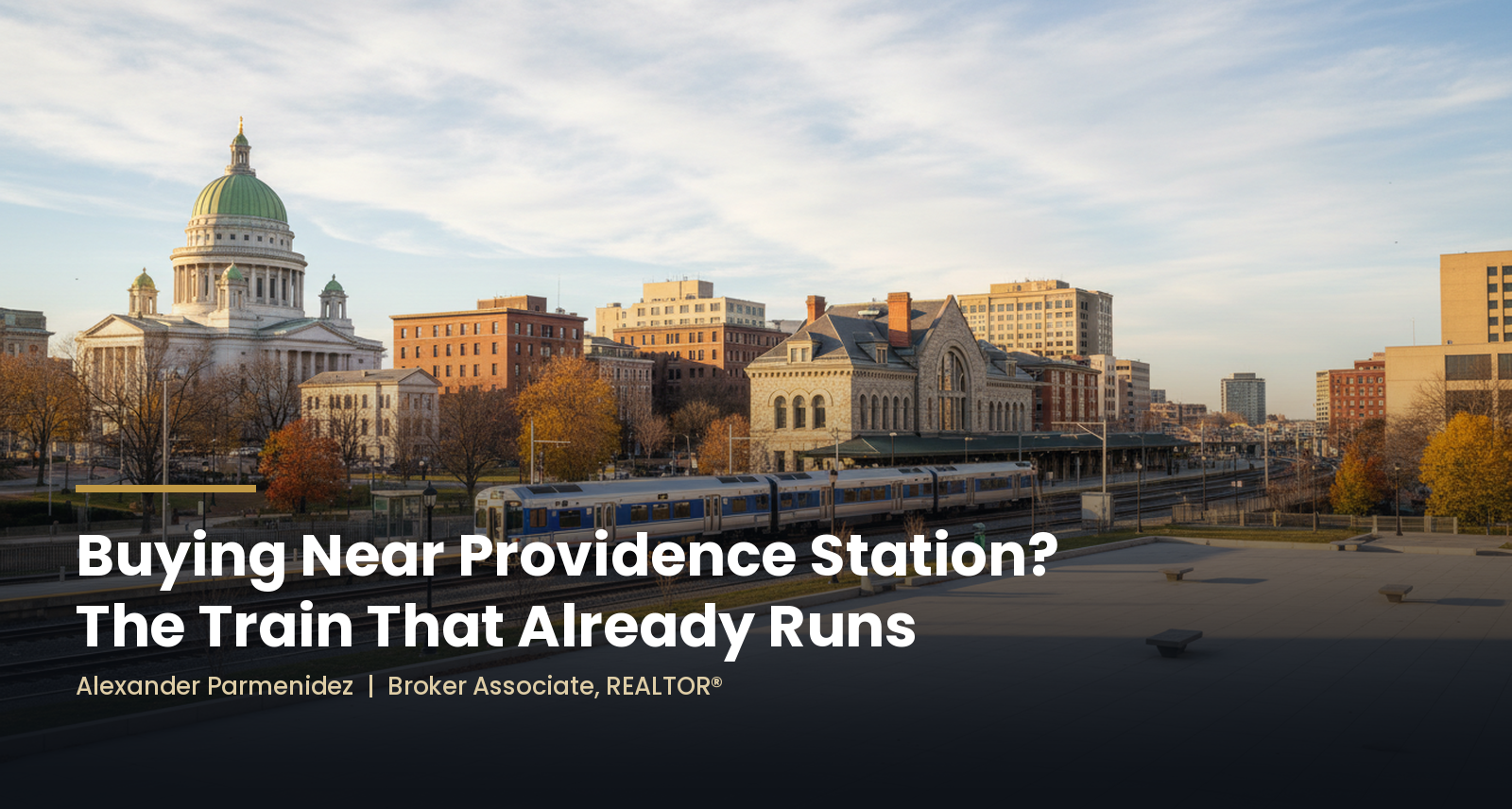
What did RIPTA actually approve in August 2026?
A design phase. Not a groundbreaking.
On August 20, 2026, RIPTA's Board authorized advancing the proposed Providence Transit Center into architectural and engineering design, federal environmental review, and coordination with Amtrak. The site is in the Station Park area west of Providence Station, along Francis Street, and structural inspections confirmed that building over the rail tunnel there is feasible.
About $77 million is committed so far — $46 million through the State Transportation Improvement Program, a $25 million federal BUILD grant, and roughly $6 million in state matching funds. Around $7 million has already gone into studies.
Here is the part that matters to you more than any of those numbers: there is no construction cost yet. No contract, no start date, no opening date. RIPTA says a comprehensive estimate gets developed through the design process, and the project also goes through an affordability review. The completed design then has to come back to the board for approval before construction can begin.
RIPTA has also said it is committed to including housing that will be affordable as part of the project, developed with housing partners. That is a stated commitment at the design stage, not a unit count you can plan around.
What that changes for you: there is no date to plan around. If a seller or an agent tells you a block is worth more today because of the transit center, ask for the construction schedule. There isn't one.
So what actually brings buyers to this part of Providence?
The train that already runs.
Let me be honest about something first. This transit center has not come up in a single conversation with my clients. Not one. It is real news, and it is not their news.
What does come up, constantly, is the commute. Most of the time the people I meet coming from Boston or New York are looking for affordability. Prices in those markets can be significantly higher than what the same budget buys here. Driving from Boston to Providence is about an hour without traffic, and New York is almost three hours. But for a daily commute between Boston and Providence, having the train station right here is a no-brainer.
That is not a future benefit. Providence sits in MBTA Commuter Rail Zone 8 on the Providence/Stoughton Line, 43.6 miles from South Station. A one-way ticket is $12.25 and a monthly pass is $388, or $378 on mTicket. Those are today's numbers, for today's service.
What that changes for you: when you are weighing a property near the station, price the commute you can actually take this year. The indoor bus-to-rail transfer that a finished transit center would add is a real improvement over walking two blocks with a suitcase in February. It is just not something you can ride yet.
How much cheaper is Providence than Boston, really?
Enough that the gap is the whole reason the commute conversation happens.
| August 2026 | Providence, RI | Boston, MA |
|---|---|---|
| Median sale price | $581,365 | $859,431 |
| Year over year | +7.7% | +3.4% |
| Median days on market | 25 | 26 |
| Sold above list | 54.7% | 30.3% |
That is a difference of about $278,000 on the median — Providence runs roughly 32% below Boston. Note that the Providence city figure covers all property types, multifamily included, which is why it sits above Rhode Island's statewide single-family median of $525,000 from the Rhode Island Association of REALTORS® August release.
My own read: that affordability could create a real influx of buyers into this area. I am not going to put a number on it, because nobody knows what unfolds. But the arithmetic above is why people keep calling.
Does cheaper mean easier to buy here?
No, and this is where I slow clients down.
Look at the last row of that table again. In Boston, about 30% of homes sold above list in August. In Providence, it was 54.7%. Days on market are effectively the same in both cities. Redfin scores Providence 83 out of 100 for competitiveness.
So the price gap is real, and the ease gap runs the other way. A buyer arriving from a more expensive market often expects the lower price to come with a slower, friendlier process. More than half the time here, they are bidding against somebody.
What that changes for you: budget for competition, not just for price. Be fully underwritten before you tour, know your ceiling per square foot, and decide your contingencies in advance rather than in the moment.
What happens to Kennedy Plaza?
It keeps frequent service. It does not keep every route.
RIPTA's project FAQ states the agency will maintain five-minute frequency to Kennedy Plaza through the Downtown Transit Connector. But reporting on the project is clear that the plaza would serve a reduced number of routes, and which routes stay, which move, and when any of it takes effect has not been settled.
What that changes for you: if you own or you are buying near Kennedy Plaza, the honest answer is that the frequency is not in question and the route mix is. Anyone who tells you the buses are leaving is overstating it. Anyone who tells you nothing changes is also overstating it. If a specific route is what makes a property work for you, that is worth watching as the design moves.
I will add my own hope here, separate from the facts. Providence Metro is emerging. Between WaterFire and everything else that already draws people downtown from around the country, I could see a more connected Kennedy Plaza facilitating that growth rather than losing out to it. How much of that materializes depends on what the city builds around it.
Does any of this change what your home near the station is worth today?
No, and this is the part I spend the most time on with clients.
An appraiser values what exists on the date of the appraisal. A lender underwrites the same way. Announced infrastructure with no construction date does not show up in an adjustment grid, and it should not show up in your list price either. The homes trading near Providence Station today are trading on the rail access, the bus access and the condition that exist right now.
Where it shows up is in the story you tell a buyer years from now, once there is something to point at. It gets priced when it gets built.
What that changes for you: if you are buying, do not pay a premium today for a facility that has not been designed yet. If you are selling, do not hold out for one either.
What about the construction years?
Proximity cuts both ways, and the disruption arrives before the benefit.
Construction, whenever it starts, will mean staging, noise and street work around Francis Street and the station area. If you own within a block or two of that parcel and you expect to sell during that window, that timing belongs in your plan now rather than later.
I will not pretend to forecast it. Honestly, it comes down to the mindset and the projections of what the buyer or seller is going to do, because nobody knows what unfolds. I think the future here is bright. How bright depends on which lens you are looking through.
What I would do if you are buying or selling near the station corridor
Buying: underwrite the property on today's rents, today's condition and today's transit. Treat the transit center as optionality you did not pay for. If a daily Boston commute is the reason you are looking here, price the monthly pass into the budget alongside the mortgage.
Selling: price on the last three comparable sales on your block, not on a rendering. If a buyer brings up the transit center, that is a reason for them to feel good about the purchase. It is not a reason to add twenty thousand dollars.
Either way: get the numbers on the specific address. A citywide median tells you nothing about your building.
About Alexander Parmenidez
Alexander Parmenidez is a Broker Associate and REALTOR® with Coldwell Banker Realty, licensed in Rhode Island, Connecticut and Massachusetts, with 14 years in the business and 275+ closings. Based in Providence, he works with first-time buyers, sellers and owner-occupants of two-to-four unit properties across the Providence metro, in English and Spanish. Learn more about Alexander.
Sources
- RIPTA, "RIPTA Board Advances Providence Transit Center to Next Phase" (Aug. 20, 2026)
- RIPTA, Providence Transit Center project FAQ
- UpriseRI, "RIPTA advances plan to move hub from Kennedy Plaza"
- Redfin, Providence RI housing market (August 2026)
- Redfin, Boston MA housing market (August 2026)
- MBTA, Commuter Rail zone fares
Frequently Asked Questions
What did RIPTA approve for the Providence transit center in August 2026?
On August 20, 2026, RIPTA's Board authorized advancing the project into its next phase — architectural and engineering design, federal environmental review, and coordination with Amtrak. Roughly $77 million is committed, but no construction cost, contract or start date exists, and the completed design must return to the board for approval before construction begins.
Will buses still serve Kennedy Plaza after the new transit center opens?
RIPTA's project FAQ says the agency will maintain five-minute frequency to Kennedy Plaza through the Downtown Transit Connector. Reporting on the project indicates the plaza would serve a reduced number of routes, and which routes stay or move has not been settled.
Does a future transit hub change what a home near Providence Station is worth today?
Not on its own. Appraisers and lenders value what exists on the valuation date, not announced infrastructure. A home near the station is priced on the rail access, bus access and condition available today.
How much does it cost to commute from Providence to Boston by train?
Providence is in MBTA Commuter Rail Zone 8 on the Providence/Stoughton Line. A one-way ticket is $12.25, and a monthly pass is $388, or $378 through mTicket. The station sits 43.6 miles from South Station.
Is it cheaper to buy in Providence than in Boston?
On the August 2026 medians, yes — $581,365 in Providence against $859,431 in Boston, a difference of about $278,000. Providence is the more competitive market on the ground, though, with 54.7% of homes selling above list compared with 30.3% in Boston.
What to do next
Send me the address or the MLS number of anything you are looking at near the station corridor, and I will send back what the last three comparable sales on that block actually did, and — if it is a two-to-four unit — whether the rents carry the payment at today's numbers. If a Boston commute is part of the plan, tell me and I will run the monthly pass into the budget with you. Call or text (401) 426-4857.
Questions about a specific block near Providence Station? Call or text Alexander at (401) 426-4857.
Looking at a 2–4 family?
Run the real numbers before you offer.
Actual versus market rents, the FHA self-sufficiency test, taxes, insurance and financing. Alexander has closed more than 275 transactions, many of them multifamily in Providence, Pawtucket and Central Falls, and will tell you plainly whether a property works.
Schedule a multifamily callEnglish or Spanish · Call or text 401-426-4857 · Contact form
196 Waterman St, Providence, RI 02906 · C: (401) 426-4857 · O: (401) 351-2017 · [email protected] · alexparmenidez.realtor