
How Much Does Owner-Occupancy Cut Your Property Tax in Providence, Pawtucket and Central Falls?
TL;DR
Does living in your own building lower your Rhode Island property tax? Yes, in Providence, Pawtucket and Central Falls, each with a different gap. Providence taxes owner-occupied 2-5 unit buildings at $7.55 per $1,000 against $14.00 for landlords. Woonsocket, Lincoln and North Providence cut your assessment instead.
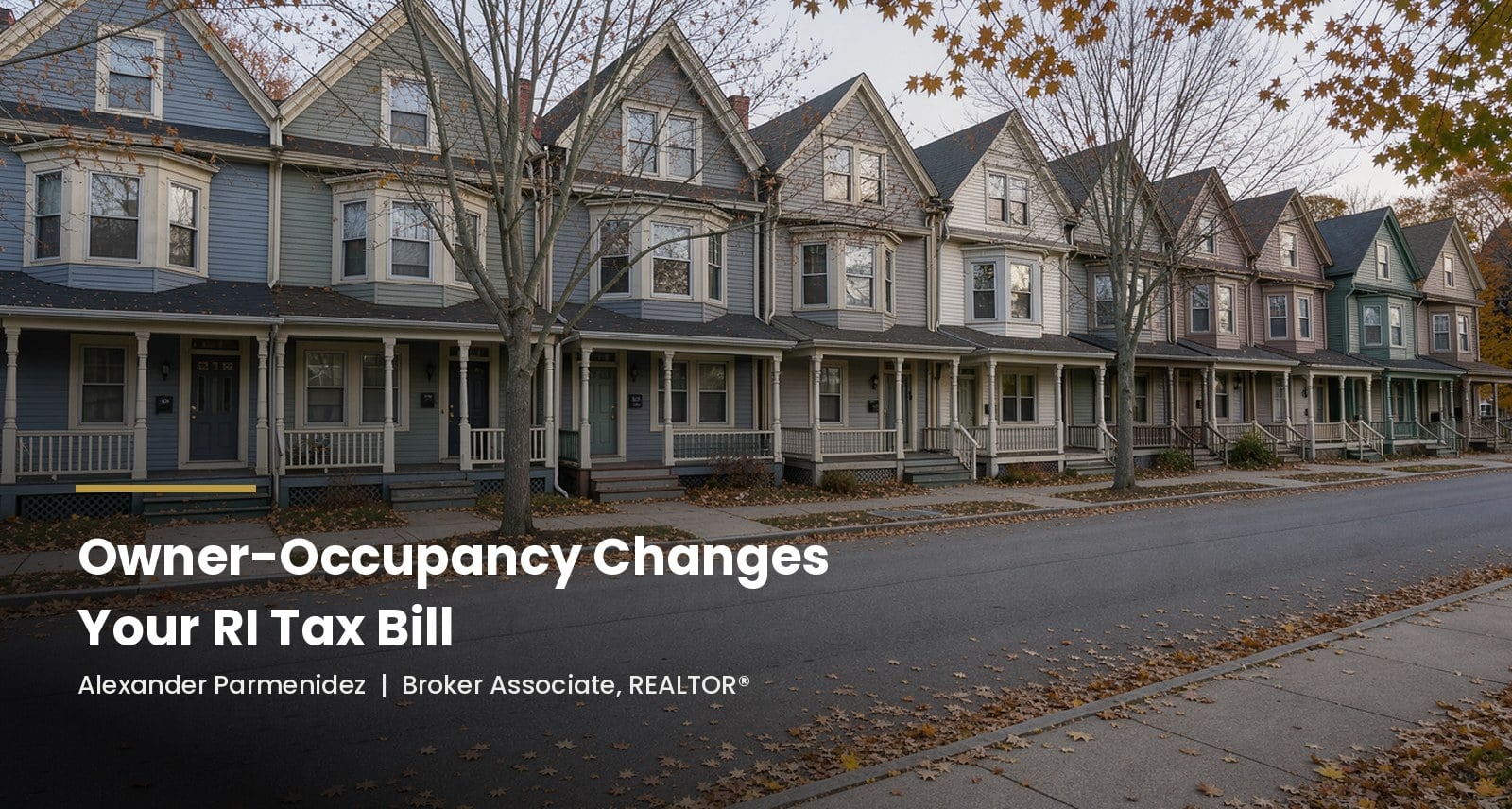
Which Rhode Island cities charge owner-occupants a lower tax rate?
Three cities in this region set a different tax rate depending on whether the owner lives in the building, and Providence has the widest gap of the three. On a two-to-five unit building the owner-occupied rate is $7.55 per $1,000 of assessed value against $14.00 for a non-owner-occupied one. On a single-family it is $8.40 against $14.60. Those figures come from the city’s adopted FY2026 tax classification ordinance.
Central Falls does the same thing on a narrower spread: $8.81 for owner-occupied residential against $13.21. Pawtucket’s gap is narrower again, $13.15 against $14.47 for its 2026 billing, and Pawtucket has no general homestead reduction beyond that rate difference.
Then there is a second group of towns that leaves the rate alone and reduces your assessed value instead:
- Woonsocket — 25% off the assessment on a single family or condominium, 10% off a two-family, 5% off a three-family.
- Lincoln — 35% off the assessed value.
- North Providence — 20% off for owner-occupied one-to-five family homes, 10% for a combination commercial and residential property.
One caution worth stating plainly. The Rhode Island Division of Municipal Finance publishes a statewide rate table, and it flags only Providence as having a separate non-owner-occupied rate. Pawtucket and Central Falls both publish one on their own assessor pages. If you are working from the state table alone, you are missing two of them. For Cumberland I could not reach a current assessor page at all, so ask the town directly rather than trusting a third-party figure.
What does the difference do to what you can afford?
Here is the case that made me want to write this.
I was representing a buyer on a two-family in Providence. We wrote the offer at $465,000, and that was under his budget, because of the way the city treats an owner who lives in the property. Then he started looking at the same kind of building in Pawtucket and other cities that did not offer the same discount, and his purchasing power dropped. I told him at the time it was at least $30,000 or $40,000, depending on the property taxes and, of course, the insurance.
I went back and ran the arithmetic for this article. On a two-family assessed at $465,000:
- Providence, owner-occupied at $7.55 — about $3,511 a year, or $293 a month in escrow.
- Pawtucket, owner-occupied at $13.15 — about $6,115 a year, or $510 a month.
That is $217 more every month. At the 30-year fixed rate Freddie Mac reported for the week ending October 22, 2026, $217 a month of payment capacity is worth roughly $31,600 of loan. Same building, same buyer, same down payment. The city decided the rest.
Had he also lost owner-occupied status on the Pawtucket building, the gap would be closer to $39,000. The rough number I gave him in the car turned out to be right.
One technical note before you run this on your own deal: property tax is charged on the city’s assessed value, which is not always the same as what you agree to pay. Use the assessment on that specific property, not the asking price.
What this changes for you is simple. The tax line is not a detail you sort out after the offer is accepted. It is part of your price range, and it can move that range by the price of a car.
How and when do you claim owner-occupied status?
In Providence the form is the Owner Occupied Certification, filed with the Tax Assessor. It asks you to declare that the property is your predominant and principal home, and to supply two forms of proof — a Rhode Island license or state ID, plus something recent such as a bank statement, mortgage statement or paystub.
The city’s adopted ordinance ties eligibility to a natural person and an application filed no later than March 15.
My own practice is to deal with this during the purchase so it does not get forgotten. But I want to be straight with you about one thing: the city’s published pages do not spell out how the timing works for a buyer who closes mid-year — whether the seller’s classification carries over for the rest of the tax year, which roll your filing lands on, or whether anything prorates at closing. Call the Assessor’s office and ask about your specific closing date. Do not assume it transfers with the deed.
And the deadlines are not the same from town to town:
- Providence — application no later than March 15, per the city ordinance.
- Woonsocket — file by January 31, ahead of the July tax bill; you must own and reside there as of December 31.
- North Providence — December 31, to be eligible for the next year’s roll.
- Lincoln — April 15, and you have to apply in person.
- Pawtucket — its exemption deadline is March 15, in person.
Miss the window and you generally wait a full tax year at the higher amount.
One more item, mostly for investors. Rhode Island now has a state-level tax on non-owner-occupied residential property, in effect since July 1, 2026. It applies only to property assessed above $1,000,000, at $2.50 per $500 of assessed value above that line. On the buildings most first-time buyers are looking at, it does not apply at all. Above that line it does, and sales of residential property assessed over $1 million now require a Certificate of No Tax Due.
Why does comparing posted tax rates give you the wrong answer?
Because a rate cut and an assessment cut are not the same machine, and only one of them shows up in a published rate.
Take a single-family home. Woonsocket posts $11.23 per $1,000 and Providence posts $8.40 for an owner-occupant. On the face of it, Providence wins by a wide margin. But Woonsocket applies its rate after taking 25% off the assessment, so measured against the property’s full assessed value it works out to roughly $8.42. Providence is $8.40. The posted rates differ by about a third. The real answer is a rounding error.
Now run the same comparison on a two-family. Woonsocket’s reduction drops to 10%, so its effective rate against full value is about $10.11, while Providence’s owner-occupied two-to-five unit rate stays at $7.55. Here Providence genuinely does win, and by a wide margin.
This is what I tell every buyer who is weighing one town against another: it depends on the municipality, so you have to be careful when comparing the numbers. You are not comparing rates. You are comparing two different systems that happen to do the same job — and which one comes out ahead changes with the number of units you are buying.
The bottom line
Providence is attractive for an owner-occupant buying a small multifamily, and the reason is specific rather than general: on two-to-five unit buildings its owner-occupied rate is the lowest number in this region once you adjust for how each town delivers the break. That is why a $465,000 two-family can sit inside a budget that the same building in the next city over would break.
But Providence is not the only city that rewards living in your own building, and the city with the lowest posted rate is not automatically the cheapest once you account for the mechanism. Investors should also keep in mind that the non-owner-occupied rate is the higher one in every city here.
So crunch the numbers. Make sure the agent you are working with knows the owner-occupancy rules for that specific city before you make an offer, because the numbers are what matter. Speak with your loan officer too, about what the tax line does to your escrow and to the amount you are approved for. You do not want to overlook something like this.
Frequently Asked Questions
Does Rhode Island have a statewide homestead exemption?
No. Property tax relief for owner-occupants is set municipality by municipality. Some cities apply a lower tax rate to owner-occupied property, while others reduce the assessed value instead. Rates and percentages are set annually, so confirm the current figure with the town assessor.
Is the lower owner-occupied rate automatic when I buy?
No. Every municipality that offers owner-occupancy relief requires an application, and some require it in person. It does not transfer from the previous owner. Ask the assessor what you need to file and by when for your closing date.
What happens if I miss the filing deadline?
You generally wait until the next tax roll, which can mean a full year at the higher amount. Deadlines differ by municipality and are not all in the same month, so check the one that applies to your city.
Can I compare two cities just by looking at their tax rates?
Not reliably. A city that reduces your assessed value can work out cheaper than a city with a lower posted rate, because the two mechanisms are not the same. Compare the actual tax on the specific property rather than the published rate.
Does owner-occupancy relief apply to a two-to-four unit building I live in?
In several Rhode Island cities it does, provided you occupy one of the units as your principal residence. The number of units a program covers varies by municipality, so confirm the rules for that city before you make an offer.
Buying a two-to-four unit?
Not sure what the tax line looks like on that building?
Send me the address or the MLS number and I will get you the owner-occupied and the non-owner-occupied figure for that specific property, before you write the offer. In English or Spanish.
Schedule a buyer callEnglish or Spanish · Call or text 401-426-4857 · Contact form
196 Waterman St, Providence, RI 02906 · C: (401) 426-4857 · O: (401) 351-2017 · [email protected] · alexparmenidez.realtor
Check out this article next
How Can Sellers Make Their Home Feel Welcoming During Fall Showings?
Fall can be an excellent season to create a warm and inviting atmosphere during home showings
Read Article