
How Much Cash Do You Need to Buy a 2-4 Family in Rhode Island?
TL;DR
Buying an owner-occupied 2-4 family in Rhode Island takes more cash than a single-family at the same price. On top of down payment and closing costs, you may face lender reserves, higher inspection and insurance costs, lead certificate compliance, and on 3-4 units, an FHA test the property itself must pass.
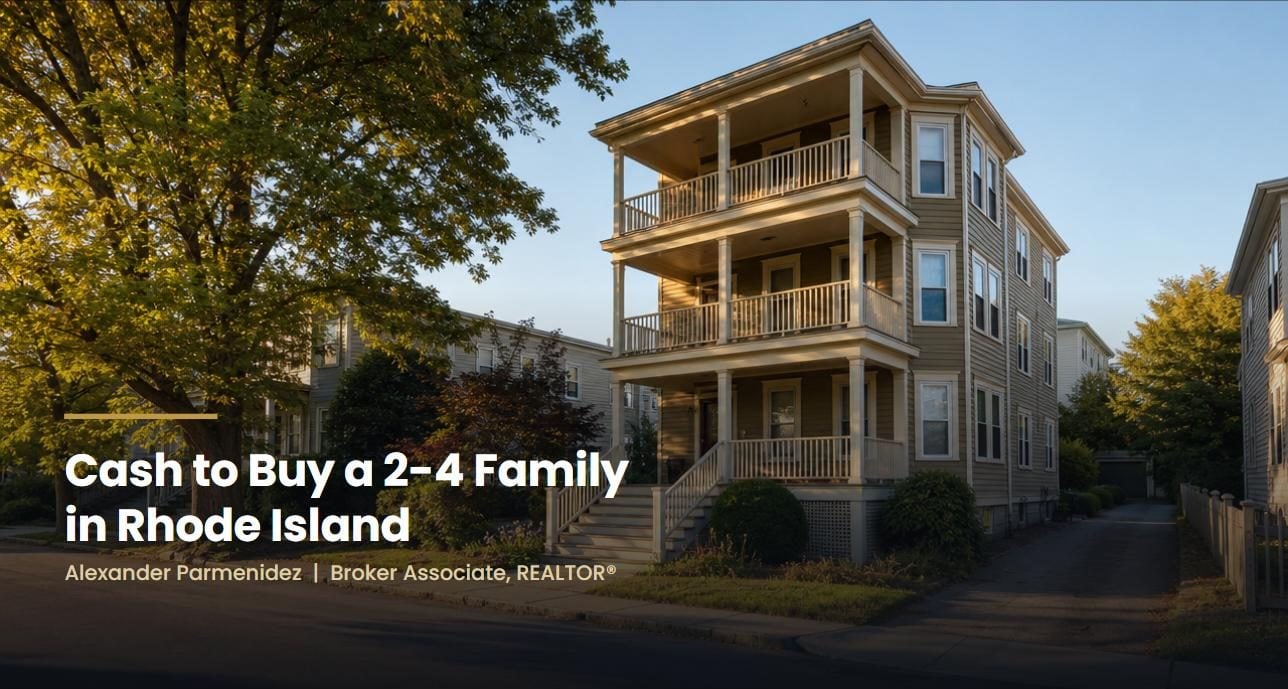
Why does a 2-4 family need more cash than a single-family at the same price?
Because the cash math is not just down payment plus closing costs. A 2-4 family adds layers a single-family buyer never encounters, and two of them can stop a deal cold rather than just cost you money.
I work with owner-occupant buyers across Pawtucket, Central Falls, Woonsocket, and Providence, and the pattern is consistent. The buyers who have a hard time are not the ones short on down payment. They are the ones who found out about reserves, or the self-sufficiency test, or a missing lead certificate after the offer was accepted.
All three are knowable before you write. That is the whole point of this article.
What is the FHA self-sufficiency test, and why can it stop a 3-4 family deal?
The rule: FHA applies a self-sufficiency test to 3- and 4-unit properties. The lender takes 75% of the gross rents from all units, and that figure must cover the entire monthly housing payment — principal, interest, taxes, insurance, and FHA mortgage insurance. If 75% of the rents does not cover the payment, the property does not qualify for FHA financing. The test does not apply to single-family or two-family properties.
What I see in the field: the test is based on the rents, and that is where deals get into trouble. You will often find low rents because there are long-term tenants who have been there for years. Those rents have to be brought up to speed with today's market rents for the numbers to work. The REALTOR®, the seller, everybody needs to understand what the rent situation is at that time to see if the numbers can make the deal happen.
When the numbers do not pass, that is essentially a hard stop. Not a repair credit, not a price negotiation — the financing structure itself does not work on that property.
How much rent a unit can command depends on the size of the apartment, how many bedrooms, the location, and the condition. With today's higher interest rates the payment side is bigger, which makes the test harder to pass than it was a few years ago. Crunch these numbers with your loan officer before presenting an offer, and make sure the seller knows about it too, because if it surfaces late it creates friction for everyone.
How much do lenders want in reserves on a 3-4 family?
The reserve is basically three months of mortgage payments. If the mortgage payment is $5,000, that would be $15,000 in reserves. That money is not going to be touched or used for the purchase. The lender wants to see that the buyer has the means to keep at least three months available in case, for example, one of the tenants walks away and there needs to be a way to keep making the mortgage payment.
This applies to three- and four-family properties. Single-family and two-family do not apply. FHA sets a three-month reserve requirement on 3-4 unit purchases, and individual lenders can require more, so confirm the number with your loan officer for your specific loan.
People ask me whether the reserve requirement changes the price range I recommend. It does not. It is part of the equation of buying a multifamily nowadays in Rhode Island. You plan for it the same way you plan for the down payment.
What do Rhode Island lead certificates mean for your purchase?
The law: Rhode Island requires a lead certificate for rental units in properties built before 1978. The Department of Health issues them — a Certificate of Lead Conformance being the most common — and they generally require renewal every two years. Pre-1978 rentals also have to be registered with the state. There are limited exemptions, including housing restricted to residents 62 and older and short seasonal tenancies. Enforcement tightened in recent years: penalties now include double and treble damages plus attorney's fees, and an owner who is not in compliance faces real limits on pursuing an eviction for nonpayment.
Important for house hackers specifically: this covers the rented units in an owner-occupied multifamily, not just buildings where the owner lives elsewhere. If you buy a three-family and live in one unit, the other two are rentals and the requirement follows them.
My take: lead certificates have been an issue in Rhode Island for many years, but the state has become much heavier on making sure properties have the required certificates. The purpose is to reduce lead poisoning, and that matters.
Sometimes the seller has not taken care of it and the buyer does not want to inherit that headache. My position is that the seller must have the lead certificates regardless of whether there is a buyer — not just because they are selling, but for their own protection. When I am on the listing side, I want the seller starting on this as early as possible, because handling it late creates friction during the transaction.
If you are buying, ask for the certificate status in writing before you go under agreement, and confirm the current requirements with your attorney. Lead law is specific and it changes.
What do inspections and insurance cost on a multifamily?
Both scale with unit count, which is the part single-family buyers do not anticipate. These are the numbers I typically see:
| Property | Home inspection | Annual homeowners insurance |
|---|---|---|
| Single-family (~2,000 sq ft) | About $500 | About $1,800–$2,500 |
| Two-family | About $700 | About $2,500–$3,500 |
| Three-family and larger | About $900 | About $3,500 and up |
Add-ons come on top: a radon test runs about $150 and up, an electrical inspection about $300 and up, and a septic inspection about $250 where it applies. Older housing stock in the Blackstone Valley can also warrant an oil tank sweep. These are ranges from my transactions, not quotes — get real numbers for your property.
Ask the inspection company for their pricing structure up front. A good inspector gives you a clear number before you book. One company I have used frequently over my career is House Doctor Home Inspection; Don Lariviere has been reliable and transparent with my clients. I receive no compensation for that mention.
Remember that inspection money leaves your account before you know whether the deal closes, and on a three-family you may want more than one specialist through the building.
What about the rest of the cash?
The four standard buckets — down payment, closing costs, inspections, and prepaid taxes and insurance — work the same way on a multifamily as on any other purchase. I covered those in detail in how much cash you need to buy a home in RI, MA, or CT. A few multifamily-specific notes:
- Seller credits still apply. With conventional financing you can generally ask for up to around 2% of the purchase price, depending on your loan structure. With FHA that can go up to around 6%. Those limits move with your loan type and down payment, so discuss with your preferred loan officer what you actually qualify for before you write the offer.
- Prepaid escrows run higher, because the insurance premium and often the tax bill are larger on a multifamily than on a single-family at the same price.
- If the building needs work, a renovation loan may let you finance eligible repairs rather than paying cash after closing. I wrote about that separately in the FHA 203(k) loan in Rhode Island. On a 3-4 unit, remember the self-sufficiency test still has to pass.
Bottom Line: what to do before you write the offer
- Get the actual rents and the market rents. Not just what tenants are paying now — what those units would rent for today. On a 3-4 unit that gap decides whether FHA works at all.
- Have your loan officer run the self-sufficiency test on the specific property before you write. Not after inspection. Before.
- Confirm your reserve requirement in writing so you know the full cash position, not just cash to close.
- Ask for the lead certificate status on every pre-1978 rental unit in the building, and confirm current requirements with your attorney.
- Get a real insurance quote for that building, at that unit count, in that town.
The thread running through all five is the same: the buyer, the lender, and the REALTOR® all have to be talking to each other from the beginning. I call them the three musketeers. On a multifamily the listing side needs to be in the loop too, because a financing problem discovered in week four creates unnecessary friction for everyone at the table.
And the advice I give every first-time buyer applies double here: do not be afraid to ask. You would be surprised what you may be able to achieve.
Frequently Asked Questions
Does the FHA self-sufficiency test apply to a two-family?
No. The self-sufficiency test applies only to three- and four-unit properties financed with FHA. On those, the lender takes 75% of the gross rents from all units and that amount must cover the full monthly housing payment, including principal, interest, taxes, insurance, and mortgage insurance. Single-family and two-family purchases are not subject to it. If a three- or four-unit property fails the test, FHA financing is not available on it, so run the numbers with your loan officer before writing an offer.
Do I need cash reserves to buy a multifamily in Rhode Island?
For a three- or four-family, generally yes. FHA requires reserves on 3-4 unit purchases, commonly measured as three months of the full mortgage payment, and individual lenders can require more. That money is not spent at closing — you have to show you have it, so the payment can be covered if a unit goes vacant. Single-family and two-family purchases typically do not carry this requirement. Confirm your specific requirement with your loan officer.
Who is responsible for the lead certificate on a rental property in Rhode Island?
The property owner. Rhode Island requires lead certificates for rental units in pre-1978 properties, and the owner must hire a licensed lead inspector and maintain the certificate, with renewal required periodically. The requirement applies to rented units in an owner-occupied multifamily as well, not only to buildings where the owner lives elsewhere. Limited exemptions exist. Requirements and enforcement have changed in recent years, so confirm the current rules with your real estate attorney.
Can I use the rental income to help me qualify for a multifamily mortgage?
Lenders will generally count a portion of the projected rental income toward qualifying, but how much depends on your loan program, the property, and the documented rents. On FHA 3-4 unit purchases, the rents also drive the separate self-sufficiency test that the property itself must pass. Because the size of each unit, the bedroom count, the location, and the condition all affect achievable rent, this has to be worked out property by property with your loan officer before you make an offer.
Is an owner-occupied multifamily more expensive to buy than a single-family?
At the same purchase price, usually yes in terms of cash required. Inspection fees and homeowners insurance premiums both rise with unit count, prepaid escrows follow the larger insurance and tax bills, three- and four-unit purchases can carry a lender reserve requirement, and rental units in pre-1978 buildings carry lead compliance obligations. The offsetting factor is rental income, which is why the full picture has to be modeled before you write rather than after.
What does a multifamily home inspection cost in Rhode Island?
In my transactions a general inspection runs about $500 on a single-family of roughly 2,000 square feet, about $700 on a two-family, and about $900 on a three-family. Add-ons are separate: radon is usually about $150 and up, an electrical inspection about $300 and up, and a septic inspection about $250 where it applies. Older buildings in the Blackstone Valley may also warrant an oil tank sweep. These are ranges from my own deals, not quotes.
Can I buy a 2-4 family with 3.5% down?
Yes, if you will occupy one of the units as your primary residence and you qualify. FHA allows 3.5% down on one- to four-unit owner-occupied properties with a qualifying credit score. The catch on three- and four-unit properties is the self-sufficiency test: the property itself has to pass, independently of how strong you are as a borrower. A two-family has no such test, which is one reason two-families are often the easier entry point.
What should I ask for before making an offer on a multifamily?
Ask for the current rent roll and the lease terms, the lead certificate status on every pre-1978 rental unit, recent utility and tax figures, and whether the seller has any open permits or code issues. Then have your loan officer run the self-sufficiency test and confirm your reserve requirement in writing. Doing this before the offer rather than after the inspection is what keeps a multifamily purchase from falling apart in week four.
Check out this article next

¿Cuánto Efectivo Necesitas para Comprar una Casa en RI, MA o CT?
Buying your first home can seem overwhelming, especially if English is not your first language or you have limited time because of work. Carlos's story…
Read ArticleLooking at a 2–4 family?
Run the real numbers before you offer.
Actual versus market rents, the FHA self-sufficiency test, taxes, insurance and financing. Alexander has closed more than 275 transactions, many of them multifamily in Providence, Pawtucket and Central Falls, and will tell you plainly whether a property works.
Schedule a multifamily callEnglish or Spanish · Call or text 401-426-4857 · Contact form
196 Waterman St, Providence, RI 02906 · C: (401) 426-4857 · O: (401) 351-2017 · [email protected] · alexparmenidez.realtor