

How to Compete in a North Providence Multiple-Offer Situation
TL;DR
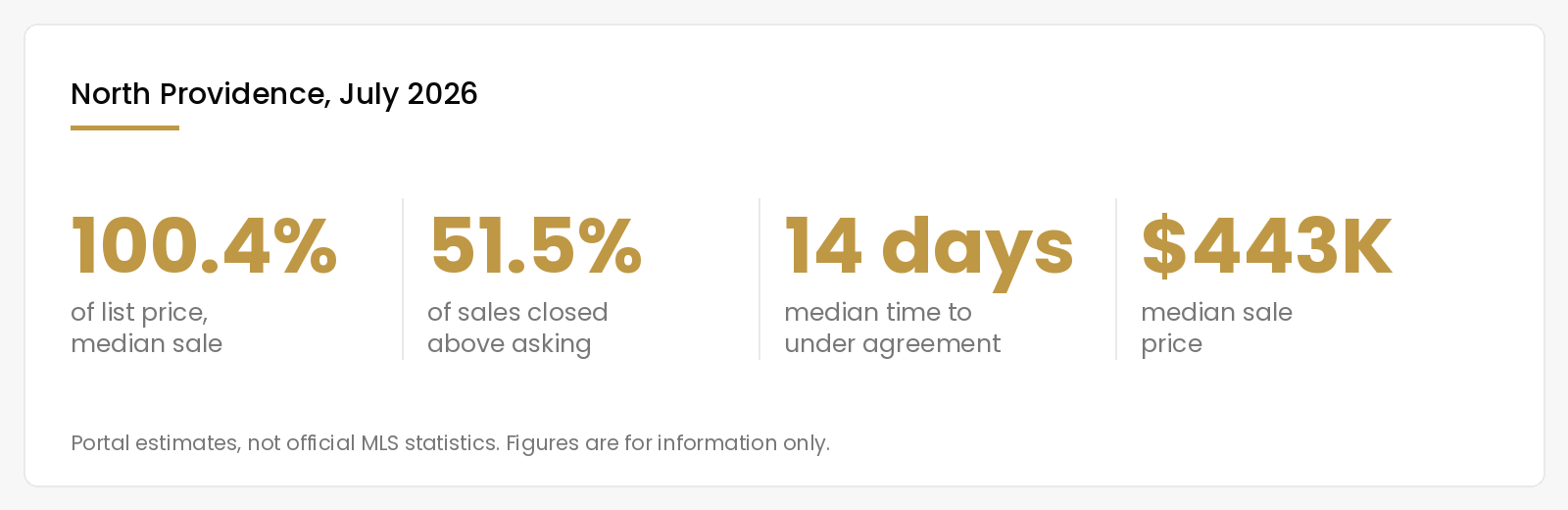
Winning a multiple-offer situation in North Providence takes more than the highest price. In July the median home sold at about 100.4% of list price, roughly 51.5% of sales closed above asking, and listings were going under agreement in about 14 days. What separates the winning offer is usually a fully documented pre-approval, an escalation clause with a hard ceiling, explicit appraisal-gap terms, inspection language your attorney has reviewed, and a closing timeline that matches what the seller actually needs.
Prefer to listen? Here is the episode

What does the North Providence market actually look like?
The supplied data shows the median home selling at about 100.4% of list price in July, with roughly 51.5% of sales closing above asking and a median sale price near $443,000. Listings were going under agreement in about 14 days, averaging around three offers per listing.
These are portal estimates rather than official MLS statistics, so treat them as the shape of the market rather than exact measurements. What they tell you in practice is that your decision window is short: tour on a Saturday, plan to think it over until Thursday, and the house is usually gone.
What those numbers do not tell you is how to construct an offer. That part comes down to preparation, and most of it happens before you ever see the listing you want.
Set expectations before you compete, not after
My whole approach to a competitive offer fits in one sentence: setting expectations at the beginning.
That means crunching the numbers with you first, so you understand your budget and what the mortgage payment actually looks like at different price points. It means walking you through the property’s condition while we are standing in it. And it means explaining what could happen — the appraisal, the inspection, the seller’s timing — before the offer goes in, rather than after.
None of that is about telling you to spend more money. It is about making sure nothing in the transaction catches you off guard, because a buyer who is surprised mid-deal is a buyer who starts renegotiating, and that is where deals fall apart.
Financing: documented, not just claimed
There is a difference between telling a seller you are qualified and showing them.
A pre-approval means a lender has already reviewed your income, your assets and your credit. A pre-qualification is a lighter look, and listing agents know the difference. Pair the pre-approval with appropriate proof of funds for your deposit and down payment, and you have reduced the seller’s uncertainty about whether the deal closes.
Neither one is final underwriting approval. But a complete, documented financing package is the floor for being taken seriously when there are three offers on the table. Talk to your lender about what documentation they can provide and how quickly they can respond to questions during the transaction.

Escalation clauses: understand the cap before you sign
An escalation clause says you will automatically raise your price above a competing offer, by a set increment, up to a stated maximum. Three parts matter: the increment, the cap — the highest price you will pay — and the verification, which specifies what counts as a bona fide competing offer and how it gets documented.
Here is what I will tell you from the field: escalation clauses can work, but not every listing agent favors them. In a multiple-offer situation, some listing agents would rather see a straightforward offer than an escalation structure. So it is not a universal tool, and no seller or listing agent is obligated to accept one.
When we do use one, you should understand the cap from the beginning. There should be no surprise at the top of that range, because the maximum should already fit the budget and the mortgage payment we worked out before we started looking.
And if the escalation is triggered and you win, the competing offer should be documented according to the terms of the clause. That is what the verification language is for. Your real estate attorney should review escalation language before it goes in front of a seller.
Appraisal gaps: real, but smaller than the internet suggests
If the appraisal comes in below the contract price, your lender generally bases the loan on the lower number. The difference between the two has to come from somewhere, and that somewhere is usually your own funds.
I want to be straight about the scale of this, because it gets talked about as though every deal blows up on the appraisal. In my own recent experience, significant appraisal-gap situations have been relatively rare. I did have one transaction where the difference was approximately $2,500, and the buyer brought the additional $2,500 to close it. That is the kind of number I have actually seen — not a catastrophe, but not nothing either, and absolutely something you want to know is possible before the appraisal comes back.
That is why I raise it ahead of time. You can decide in advance whether you are willing to cover a shortfall, whether to cap that obligation at a specific dollar amount, whether to renegotiate, or whether to exercise the contract’s appraisal provisions. Any of those is a reasonable answer. Not having thought about it is the problem.
Inspection: prepare the buyer at the showing
This is the part of a recent North Providence competitive situation that actually mattered, and it had nothing to do with the price.
The strategy centered on the inspection period. While we were walking the property, I prepared the buyer for its condition — what we were looking at, what it would likely mean, what to expect. The purpose was to keep the buyer from becoming overwhelmed later and suddenly asking for things that could have been anticipated from the beginning.
I want to draw a line here, because these two things get conflated constantly: setting expectations about condition is not the same as waiving an inspection. They are different decisions. One is preparation. The other is giving up a contractual right.
There is a range of ways an inspection can be handled in a competitive offer — a traditional inspection contingency, a narrower contingency focused on significant defects, or other negotiated terms. Which one fits depends on the property, your tolerance for risk, and what the contract says, and the exact language should be drafted or reviewed by your attorney.

Bottom line: timing, the deposit, and why no formula wins every time
Price is the term buyers think about. Timing is the one they overlook, and it costs nothing.
I ask about the seller’s timing on every competitive offer. On a recent transaction the seller needed additional time because they had not yet found their next property. My buyer was not in a rush. We established that expectation as part of the offer and used the buyer’s flexibility to help make the transaction work. Sometimes the term that wins is the one that solves the seller’s problem rather than raising your own cost.
Earnest money works the same way. A larger deposit signals that you are serious and financially prepared; a thin one on a competitive offer can read as hesitation. It is negotiable, it is typically held in escrow, and there is no fixed Rhode Island requirement for what counts as strong.
None of this guarantees your offer gets accepted. Sellers weigh offers differently, listing agents have preferences, and sometimes someone simply wants the house more than is rational. What preparation does is make sure that when you are in the conversation, you are in it with your numbers settled, your financing documented, your expectations about the property set, and terms that give the seller a reason to choose you beyond the top line.
Closing dates, possession and occupancy arrangements all have legal and practical implications. Whatever gets agreed should be in the contract, drafted or reviewed by your attorney.
Frequently Asked Questions
How do I make my offer stand out in a North Providence multiple-offer situation?
A strong offer combines a documented pre-approval with appropriate proof of funds, a price structure you have already run against your budget, a clear position on the appraisal, inspection terms your attorney has reviewed, and a closing timeline that works for the seller. Price is one variable among several — an offer that is well constructed across all of them can outperform a higher number that is thin on terms.
Should I offer more than the asking price for a North Providence home?
The supplied market data shows about 51.5% of July sales closing above asking at a median sale-to-list ratio near 100.4%, so going above list is common. Whether you should on a specific property depends on that listing, how long it has been on the market, and what your budget and mortgage payment support. Going above asking without a defined ceiling is the part to avoid.
How does an escalation clause work in Rhode Island?
It raises your price above a competing offer by a set increment, up to a maximum you define, and specifies how a bona fide competing offer is verified and documented. Not every listing agent favors them — some prefer a straightforward offer in a multiple-offer situation — so it is not a universal tool. Your real estate attorney should review the language before submission.
What happens if the appraisal comes in below my offer price?
Your lender will generally base the loan on the lower appraised value, leaving a difference you would need to cover, renegotiate, or address under the contract’s appraisal provisions. In my own recent experience, significant gaps have been relatively rare; one transaction involved a difference of approximately $2,500, which the buyer brought to closing. Deciding your position in advance is more useful than reacting to it afterward.
Can I waive the home inspection and still protect myself?
Waiving an inspection removes your ability to negotiate or withdraw based on what is found, which is a real risk. Preparing yourself for a property’s condition before you write is a different thing entirely, and it is the part I focus on. The range of inspection structures and what each one gives up is a conversation for a specific property, with your attorney reviewing the language.
Does a flexible closing date actually help my offer?
It can. On a recent transaction the seller needed additional time because they had not yet found their next property, and my buyer was not in a rush — that flexibility became part of the offer and helped the transaction work. Ask what the seller needs before assuming a fast close is an advantage.
How much earnest money should I put down on a competitive offer?
There is no fixed Rhode Island requirement. The deposit communicates seriousness and is typically held in escrow until closing, and the right amount depends on the price point and the transaction. Discuss it with your attorney before submitting.
How quickly do I need to act on a North Providence listing?
The supplied data put the median time to under agreement at roughly 14 days, and many sellers set an offer deadline shortly after an open-house weekend. The practical answer is that your financing and your numbers should be settled before you tour, so that the offer is a decision rather than a scramble.
Check out this article next

¿Es el Otoño un Buen Momento para Comprar una Casa en Rhode Island?
El otoño puede ser una temporada importante para quienes buscan comprar una vivienda en Rhode Island
Read ArticleCompeting on a North Providence house?
Let us walk that house before you write.
The numbers, the mortgage payment, your escalation ceiling, where you stand on the appraisal, and the terms that matter to this particular seller. Alexander has closed more than 275 transactions across the Providence metro and will go through one specific property with you before you submit.
Schedule a callEnglish or Spanish · Call or text 401-426-4857 · Contact form
196 Waterman St, Providence, RI 02906 · C: (401) 426-4857 · O: (401) 351-2017 · [email protected] · alexparmenidez.realtor