
Outbid on a Providence House? What Actually Decides the Winner
TL;DR
Why do buyers still get outbid when there are more homes for sale? More inventory has not ended competition on every property. A listing priced to draw attention can still pull multiple offers — and the winning one is rarely decided by price alone.
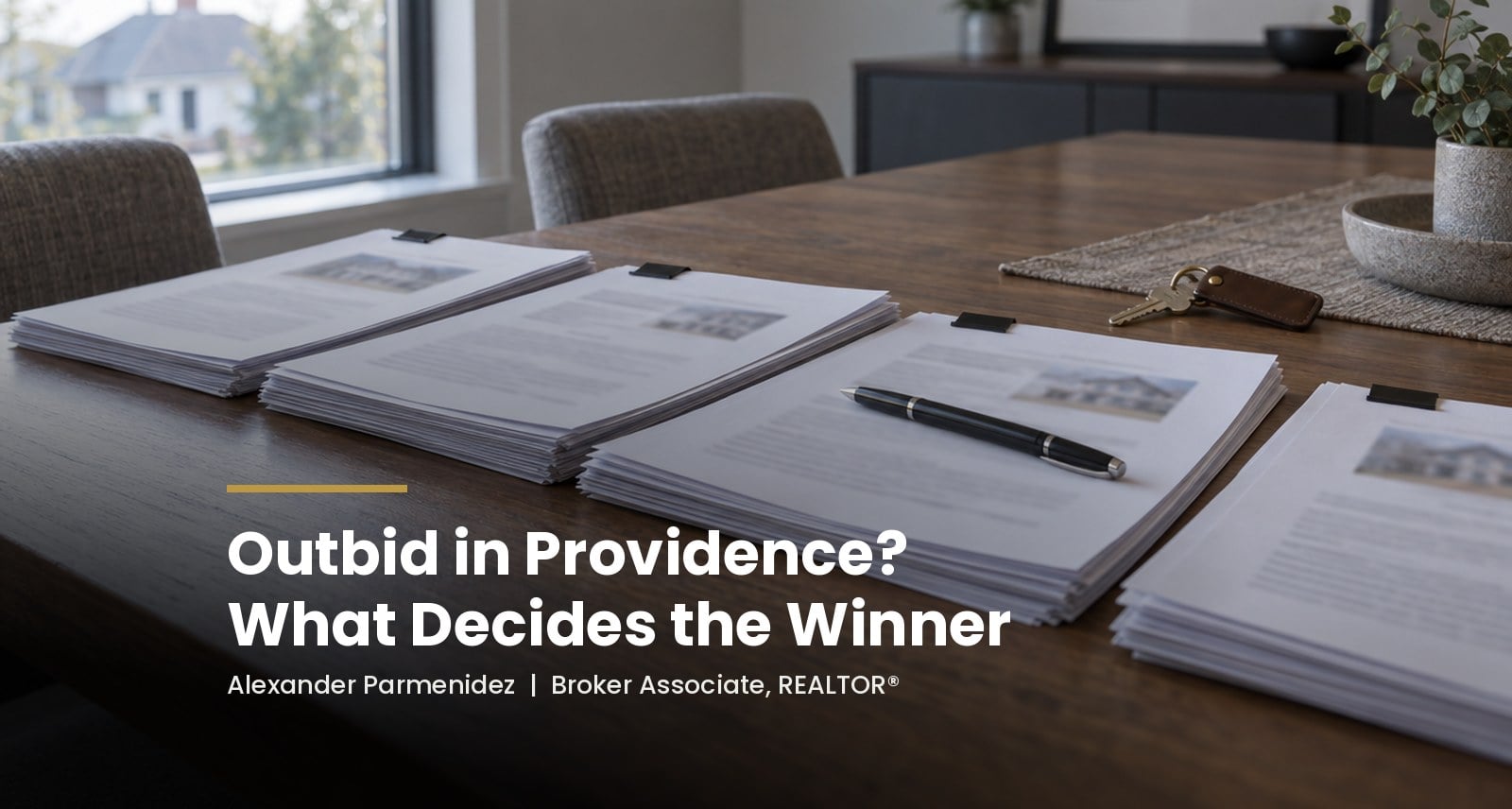
Why are buyers still getting outbid when there are more homes for sale?
Because a bidding war is often made, not found.
The county numbers point one way. Providence County had 891 active listings in September 2026 against 744 in September 2025 — close to 20% more homes on the market. Over the same year the median list price moved from $469,900 to $479,900, about 2%. More choice, prices close to flat. Those are Realtor.com figures published by FRED, not Alexander Parmenidez's own data.
And buyers are still losing offers. Alexander saw a single-family in Pawtucket that, according to the listing Realtor, drew roughly twenty showings over one weekend and five offers.
His read on why: the property looked to him like it had been listed below what it would actually sell for, to pull attention and create competition. That is his professional interpretation, not something the listing agent confirmed — worth holding as a hypothesis rather than a fact. But it points at something useful. A crowd around one listing is not proof the whole market is tight. It can be a pricing decision.
One more thing he is careful about: what counts as a competitive price depends heavily on the property type. Single-family homes, condominiums and multifamily buildings sit at different levels, and a number that signals competition in one does not signal it in another. So "is this market competitive?" is a less useful question than "is this competitive for the kind of property I am actually shopping for?"
What actually decides which offer wins?
Not the number on its own.
When Alexander describes what makes an offer competitive, he lists things that move together: the purchase price, the deposit, the closing timeline, the inspection terms, closing costs, how the offer is communicated to the listing agent, and how clearly it is put together.
He puts real weight on that last part. In his words: "There's always how you present yourself and also being able to communicate with the Realtor and presenting a very well structured offer." Asked whether he meant financial strength, fewer contingencies, or something else, he narrowed it to two words — clarity and presentation.
That is worth sitting with, because it is the part a buyer can improve without spending more money. An offer a listing agent can read quickly, explain to their seller accurately, and trust is complete is doing work that a slightly higher number may not do.
When his buyers lose, what he hears back from listing agents is usually brief: a higher offer, or better terms. That is honest about the limits of the information. It does not identify which single thing decided it, and this article is not going to invent a ranking — Alexander did not claim one, and the feedback agents give rarely supports one.
How do you decide what your top number is?
Before the competition, not during it.
Alexander builds that number from his read on the local market, the buyer's budget, the condition of the property, what else is available, and what the buyer is genuinely comfortable with. He draws a distinction between a buyer who needs to move and one who is looking casually — the first group, in his description, is hungry, and behaves differently when a property is contested.
What he does not offer is a formula. There is no multiplier here, and inventing one would misrepresent how he works.
He is direct about the limit: "If they cannot go more than the ceiling, there's nothing we can do." That sounds blunt, but it is the useful part. The ceiling is a decision made in advance, by the buyer, and the whole point of setting one is that it still holds when a property you want is in front of you.
Price is not the only lever, though. Sometimes it is the price and sometimes it is the conditions, as he puts it. Where a buyer cannot go higher, the terms of the offer are the remaining room — which loops back to structure and clarity.
Do escalation clauses work in Rhode Island?
Sometimes, and it depends a great deal on who is on the other side.
An escalation clause says a buyer will beat a competing offer by a set amount, up to a stated maximum. In Alexander's experience in Rhode Island, how useful that is comes down to the listing Realtor. Some understand the mechanism and are open to it. Some are not familiar with how it works. And some simply will not accept offers that contain one.
So an escalation clause is not automatically an advantage here. It is a tool whose value depends on the agent receiving it — another reason the communication part of his answer matters. Knowing how the listing side tends to work is part of knowing whether the tool helps at all.
What to do after you lose one
Treat it as information for the next one.
Alexander's view is that a buyer who loses an offer can use the experience to reconsider their approach when another opportunity comes. That is not a consolation prize. Losing one is the clearest look most buyers get at how competitive their actual search is, and it arrives before they are committed to anything.
Worth revisiting afterwards: whether the ceiling you set was a real number or an optimistic one, whether your offer was easy for a listing agent to read and act on, whether your financing documentation was ready rather than promised, and whether the property that drew a crowd was priced to draw one.
On contingencies — the inspection, financing and appraisal protections written into your agreement — buyers often ask whether shortening or removing them is the way to compete. They are real protections, and removing one transfers real risk to you. That is a decision to make with your own agent and attorney against your own circumstances, not a lever to pull because a property is busy. This paragraph is general information rather than Alexander's recommendation: he declined to discuss his own approach to contingencies, on the grounds that it is part of how he negotiates for his clients.
One boundary worth naming. Everything here is about decisions made before a seller accepts. What can still undo a deal after acceptance — the loan, the dates, the deposit — is a separate problem, and it is covered in its own article.
Frequently asked questions
Why would a home get multiple offers when there are more homes for sale?
More inventory across a county does not mean every listing is equally exposed to it. A property can draw concentrated interest for reasons specific to that property, including how it is priced relative to what buyers believe it will sell for. Competition on one listing is not evidence about the whole market.
Is the highest offer always the one a seller accepts?
No. Price sits alongside the deposit, the closing timeline, inspection terms and closing costs, and sellers weigh those together. How clearly an offer is presented and communicated can also affect how it is received.
What should I do differently after losing a bidding war?
Revisit whether the ceiling you set was realistic, whether your offer was clear and complete enough to act on easily, and whether your financing documentation was ready. Losing an offer is usually the clearest information a buyer gets about how competitive their search actually is.
What is an escalation clause, and will it help in Rhode Island?
An escalation clause commits a buyer to beat a competing offer by a set amount, up to a stated maximum. Whether it helps depends partly on the listing agent: some are receptive, some are unfamiliar with it, and some decline offers that include one. It is not automatically an advantage.
Should I waive contingencies to make my offer more competitive?
Contingencies are protections, and removing one shifts risk onto you. Whether that trade makes sense depends on your circumstances, the property and your financing, so it is a decision to make with your own agent and attorney rather than a default move in a competitive situation.
Outbid on a property in Rhode Island?
Not sure whether the one you lost was genuinely competitive?
Send me the listing you lost, or the one you are about to bid on, and I will give you a read on whether it is actually competitive for that property type and what I would change on the next offer. In English or Spanish.
Send me the listingEnglish or Spanish · Call or text 401-426-4857 · Contact form
196 Waterman St, Providence, RI 02906 · C: (401) 426-4857 · O: (401) 351-2017 · [email protected] · alexparmenidez.realtor
Check out this article next

Cómo Vender una Casa con Problemas de Título de Propiedad en Rhode Island
A menudo es posible vender una casa con problemas de título de propiedad en Rhode Island, pero las disputas de propiedad, los gravámenes o la…
Read Article