
Lincoln, RI Multifamily Investment 2026: What the Market Turn Means
TL;DR
Lincoln multifamily has turned. Median multifamily sale prices fell 10.4% year-over-year in Q2 2026 to $582,500, average days on market rose from 27 to 44, and sales volume ticked up. That is the opposite of the ultra-tight conditions of 2024 and early 2025. For patient investors the shift is an opening rather than a warning: well-maintained buildings still draw competition, but sellers no longer set the terms, and buyers who underwrite conservatively finally have room to negotiate. Rhode Island new non-owner-occupied property tax and a rising metro vacancy rate belong in every underwriting model this year.
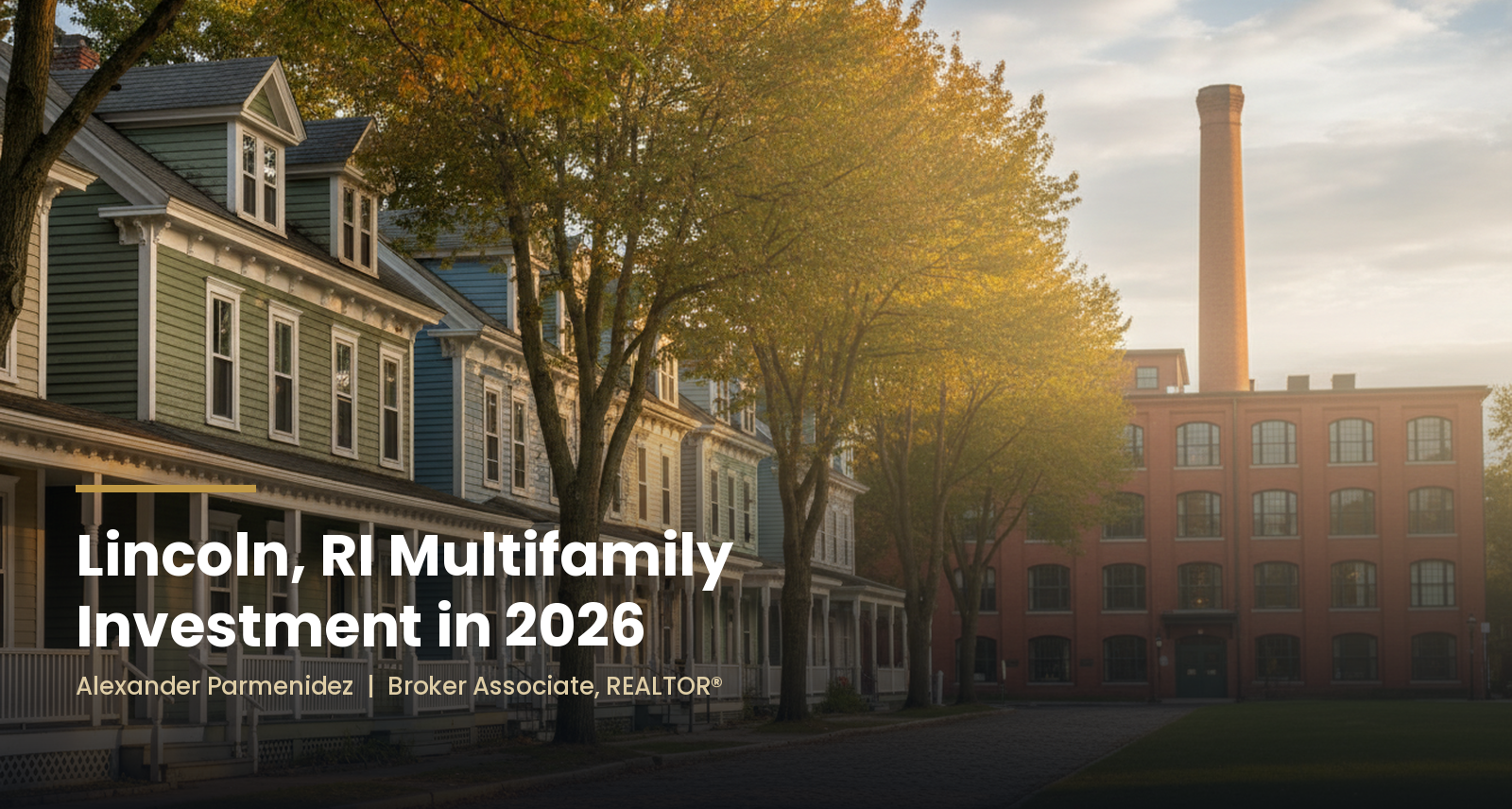
What Lincoln Multifamily Actually Looks Like Right Now
Lincoln is a suburban town in Providence County, roughly 10 to 15 minutes north of downtown Providence via I-95 and Route 146. That commuter geography is the foundation of its rental demand. Tenants who work in Providence but want a lower-density setting are the profile that fills duplexes and three-families in Lincoln older mill-village areas — Saylesville, Lonsdale, and Manville.
Here is what the current data says, and it is not what most investors expect. The Rhode Island Association of REALTORS® tracks multifamily sales by town. For Lincoln, the second quarter of 2026 against the same quarter in 2025:
| Metric | Q2 2025 | Q2 2026 | Change |
|---|---|---|---|
| Multifamily sales | 7 | 8 | +14.3% |
| Median sale price | $649,900 | $582,500 | −10.4% |
| Avg. days on market | 27 | 44 | +63.0% |
More transactions, lower prices, and properties taking well over a month to sell. If you read an article from last year describing Lincoln as a market where investors compete hard for every listing, that description was accurate then and is not accurate now.
The statewide picture confirms the direction. Rhode Island median multifamily sale price peaked at $637,500 in March 2026 and has slid to $590,000 as of June, according to Rhode Island Association of REALTORS® data reported by the Providence Journal. Multifamily outperformed single-family on the way up since 2020, and it is giving some of that back.
One nuance worth flagging: the portals disagree about Lincoln right now. Zillow home value index for Lincoln reads $562,659 as of July 31, 2026, up 5.1% year-over-year. Redfin median sale price for the town reads $499,728 for June 2026, down 3.9%. Those measure different things — an index of all homes versus the median of what actually transacted in a town with very few sales. When a market is this thin, expect the numbers to disagree, and do not build an offer on a single portal headline.
The broader Providence metro remains firmer than Lincoln specifically. A May 2026 tracker put the metro median sale price at about $520,000, up 2.0% year-over-year, with roughly 2.5 months of supply, a median of 25 days on market, and 51.9% of properties closing above asking.
Lincoln or Providence Proper? The Question I Get Most
Almost every investor who calls me about Lincoln is really asking a comparison question. They want to know whether to put money in a lower-density suburban town or in the city where the deal flow is.
Here is how I answer it. Lincoln is not a get-rich-quick investor market. To me it is a sleep-well-at-night market. Steady transaction patterns, high owner-occupancy, access to Providence and the rest of the Blackstone Valley, and historically solid rental demand. For the right investor it is about stability, long-term appreciation, and protecting the capital you put in. That is what made me start paying attention to Lincoln, and it is still what I look at today.
Providence proper gives you volume. More buildings trade, comps are easier to verify, and you will see more deals in a given month. It also gives you more competition from new construction, which matters more in 2026 than it did two years ago.
Lincoln gives you a differentiated tenant position and far fewer transactions. Eight multifamily sales in a quarter is a thin market. Comps are limited, pricing is lumpy, and you may wait months for the right building. The upside is that when you do find one, you are not bidding against a dozen investors the way you would have been in 2024.
Something else I have noticed after years working across Lincoln and the Blackstone Valley: a lot of these multifamily buildings are stronger than people expect. Depending on where you are in town, you can get a lower-density setting and still capture the income of a two-to-four unit. That combination is not easy to find this close to Providence.
And here is what I am seeing on the ground right now. Well-maintained product still competes. A three-family with updated mechanicals, a dry basement, and stabilized tenants will still draw multiple offers in this town. Tired product sits, and it sits far longer than it did a year ago. The 44-day average masks a real split between those two categories.
If you are weighing Lincoln against its neighbor, my Cumberland, RI real estate investment analysis covers a similar suburban thesis one town over. For a sense of Lincoln itself beyond the numbers, I wrote a guide to living in Lincoln that covers its villages, parks, and history.
Cap Rates, Cash Flow, and What the Numbers Mean for a Lincoln Deal
Cap rate is where a lot of investor conversations start and where a lot of them go wrong.
Rhode Island multifamily cap rates averaged roughly 7.7% across 2025 and have compressed to about 6.8% year-to-date in 2026, according to Northeast Private Client Group Rhode Island market report, at an average of roughly $277,000 per unit. That compression matters. A market cap rate is an average across every building that traded, including stabilized, well-located, and fully renovated product. Your specific duplex or three-family is not the average.
So here is what I tell every investor who asks me to look at a building. Do not judge it on cosmetics. Look at the bones first — the location, the roof, the mechanicals, the condition of the major systems. Paint and staging are the cheapest things in the building to fix. A failing heating system across three units is not.
Then look at the numbers, and be specific about which ones. What is the rent-to-price ratio? What is the cap rate on actual in-place rents, not pro forma? What are the real operating expenses? What vacancy are you assuming? And what do market rents actually support at this specific address, not town-wide?
Taxes and insurance belong in that math too, along with any homestead benefit that applies if you plan to occupy a unit. Those line items move the bottom line more than most investors expect, and they are the ones that tend to get estimated instead of verified.
Not every property is a good investment just because it is a multifamily.
I say that a lot, and it is not always what an investor wants to hear. Sometimes someone falls in love with a building, or with what it could become, and my job is to bring them back to the numbers. Sometimes the numbers simply do not work. I would rather tell a client to walk away from a property today than watch them buy something they regret six months or a year from now.
That said, at a Lincoln multifamily median near $582,500, financed at today rates with a standard investor down payment, most deals do not produce meaningful cash flow in year one. That is not a Lincoln problem. It is true across most of the Providence metro right now.
What has changed in your favor is the negotiating position. When properties sold in 16 days, your underwriting had to be aggressive to win. At 44 days, you can underwrite to what the building actually supports and still transact. That is the real story of 2026 for buyers, and it is worth more than a headline cap rate.
Zillow puts average rent in Lincoln around $2,267 as of July 2026, but that is a town-wide figure and no specific unit rents at the average. For investors with a five-to-ten-year horizon, constrained supply and durable commuter demand still make a real argument. For someone who needs strong day-one cash flow, the numbers need careful, property-specific work before anyone draws a conclusion.
Two Rhode Island Rule Changes Investors Need to Know
Two things changed in Rhode Island in 2026 that affect multifamily investors directly. Neither gets much coverage, and both come up in my conversations with clients.
The Non-Owner-Occupied Property Tax
Effective July 1, 2026, Rhode Island imposes a state-level tax on non-owner-occupied residential property: $2.50 per $500 of assessed value above $1,000,000, paid quarterly on September 15, December 15, March 15, and June 15.
The exemptions are what matter for multifamily buyers. A multi-family building is exempt as long as one unit is owner-occupied, or where the property is rented for 183 or more days a year under the Residential Landlord and Tenant Act. So a house-hacker living in one unit of a three-family is outside it, and so is a conventionally leased, year-round rental.
Where it bites is the second home or the underused property held above the $1M assessment line. Most Lincoln two-to-four-unit buildings sit well below that threshold today, but if you are assembling a portfolio or looking at larger buildings, model it. Details are on the Rhode Island Division of Taxation page.
The Survivor Early Lease Termination Act
Signed into law on June 18, 2026, this act allows survivors of domestic violence and related abuse to terminate a lease early without penalty, vacate within 30 days, and recover prepaid rent and the security deposit. It also allows tenants to request lock changes. Verification requires written documentation from law enforcement, an attorney, a healthcare provider, a social worker, a therapist, or an advocate.
If you own rental property in Rhode Island, this belongs in your lease template and your vacancy assumptions. Talk to a Rhode Island attorney about how to implement it correctly.
Both of these sit on top of Rhode Island existing landlord-tenant framework, the Residential Landlord and Tenant Act, RIGL Chapter 34-18. If you are new to Rhode Island as a landlord, read it before you close. I can point you to resources, but I always recommend investors consult a Rhode Island attorney on any lease or tenant matter with legal implications.
Risks to Underwrite Before You Buy in Lincoln
I do not think Lincoln is a risky market. But every investment carries real risk, and I would rather walk through them now than after you have signed a purchase agreement.
New construction is landing in the suburbs, not just the city. More than 1,800 multifamily units were under construction across the Providence metro as of the first quarter of 2026, the highest quarterly total since mid-2022, according to CoStar — and roughly 92% of that pipeline is suburban rather than urban. That is a meaningful change from the last cycle, when new supply concentrated downtown. Older mill-village stock in Lincoln has location and character advantages, but it will compete with newer suburban product for the same renters. Condition matters more than it did when vacancy was near zero.
Metro vacancy is rising. CoStar reported in June 2026 that Providence multifamily vacancy reached 4.5%, the highest level since early 2017. That is still a functional market, not a distressed one. But the direction is up, and underwriting that assumes near-zero vacancy or 5 to 8% annual rent increases belongs to 2021, not now.
Transaction volume is thin. Eight multifamily sales in a quarter means limited comparable data and lumpy pricing. Be ready when the right building appears: pre-approval in hand, underwriting assumptions already stress-tested, and a clear walk-away number.
Property taxes and operating costs. Lincoln FY2026 residential tax rate is $13.52 per $1,000 of assessed value, per the Rhode Island Division of Municipal Finance. Note that the Town of Lincoln own assessor page still displays rates labeled 2023 — another reason to verify the actual tax bill on any specific property with the Town of Lincoln Tax Assessor rather than relying on a portal estimate or a stale table.
The Regional Portfolio Angle
Because I am licensed in Rhode Island, Massachusetts, and Connecticut, I work with investors building portfolios across all three states. Lincoln can be a solid anchor position: constrained supply, commuter demand, and a suburban tenant profile that holds up.
If pricing in Lincoln does not pencil for a specific deal, there are comparable suburban markets in Massachusetts and Connecticut where the same thesis applies at different price points and cap rate profiles. Cross-border diversification is a real strategic option, and having one agent who can legally represent you in all three states simplifies the process.
Frequently asked questions
Is Lincoln, RI a good place to invest in multifamily real estate in 2026?
Lincoln offers constrained supply, commuter access to Providence, and a suburban tenant profile that supports stable occupancy. What changed in 2026 is the entry point: median multifamily prices fell 10.4% year-over-year in Q2 2026 to $582,500, and average days on market rose from 27 to 44. That means less competition and more room to negotiate than investors had in 2024 and 2025. It suits a five-to-ten-year hold better than a day-one cash flow strategy at current financing costs.
Should I buy multifamily in Lincoln or in Providence proper?
Providence gives you deal flow, easier comps, and more transactions per month, along with more new-construction competition. Lincoln gives you a differentiated suburban tenant position and far fewer transactions — eight multifamily sales in Q2 2026. Broadly, cash flow tends to be easier to find where entry prices are lowest relative to rents, and appreciation and occupancy stability tend to favor supply-constrained suburban towns. Your entry price largely decides which strategy is available to you.
What are multifamily prices and days on market in Lincoln, RI right now?
Per Rhode Island Association of REALTORS® town-level data, Lincoln multifamily properties had a median sale price of $582,500 in Q2 2026 across 8 sales, with an average of 44 days on market — down 10.4% in price and up 63% in days on market versus Q2 2025. Statewide, Rhode Island multifamily median was $590,000 in June 2026, down from a $637,500 peak in March 2026.
Does Rhode Island new non-owner-occupied property tax apply to my Lincoln rental?
The tax, effective July 1, 2026, applies at $2.50 per $500 of assessed value above $1,000,000. Multi-family properties are exempt where one unit is owner-occupied, or where the property is rented 183 or more days a year under the Residential Landlord and Tenant Act. Most Lincoln two-to-four-unit buildings assess well below the $1M threshold, but verify your specific assessment and confirm treatment with your tax advisor.
What should I check before making an offer on a Lincoln multifamily?
Pull the actual tax bill from the Town of Lincoln assessor rather than a portal estimate — Lincoln FY2026 residential rate is $13.52 per $1,000. Verify in-place rents against leases, not asking rents. Budget for condition, since well-maintained buildings are holding occupancy and tired ones are sitting. Model rising metro vacancy, which CoStar put at 4.5% in June 2026. And understand Rhode Island landlord-tenant framework, including the Survivor Early Lease Termination Act signed in June 2026, before you close.
Understanding Lincoln investment potential is one thing. Knowing whether a specific building pencils out at today prices and rates is something else, and that is where property-level analysis makes the difference.
If you are evaluating a deal or want to understand what is actually available in Lincoln right now, call or text me at 401-426-4857, or explore current listings and market data at alexparmenidez.realtor. I work with multifamily investors across Rhode Island, Massachusetts, and Connecticut, and I am happy to run the numbers with you before you commit to anything.
Check out this article next

¿Necesitas un 20% de Enganche para Comprar una Casa? La Verdad Sobre los Pagos Iniciales
Uno de los mayores mitos al comprar una casa es que necesitas un enganche del 20%.
Read ArticleLooking at a 2–4 family?
Run the real numbers before you offer.
Actual versus market rents, the FHA self-sufficiency test, taxes, insurance and financing. Alex has closed more than 275 transactions, many of them multifamily in Providence, Pawtucket and Central Falls, and will tell you plainly whether a property works.
Schedule a multifamily callEnglish or Spanish · Call or text 401-426-4857 · Contact form
196 Waterman St, Providence, RI 02906 · C: (401) 426-4857 · O: (401) 351-2017 · [email protected] · alexparmenidez.realtor