
Why Your List Price in North Providence Has to Be Right the First Week
TL;DR
Why does the list price on a North Providence home have to be right in the first week? Because the buyers watching your price band see your listing in its first few days, and a reduction three weeks later reaches a smaller, colder audience. Portal estimates disagree by $20,000 on North Providence alone, so they can’t set your number.
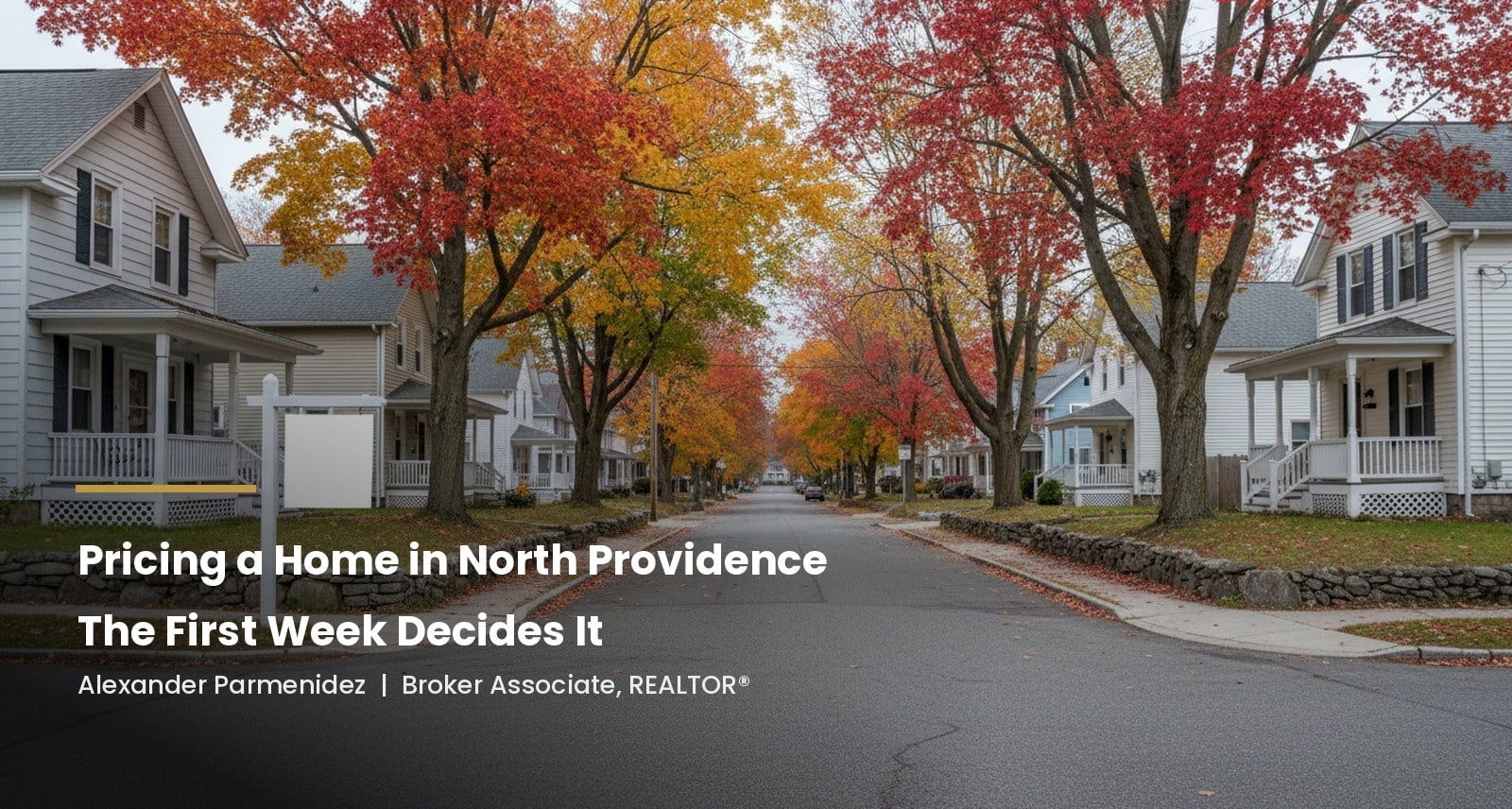
How should you price a home in North Providence?
Almost every seller I sit down with in North Providence says some version of the same sentence: “Let’s start here, and we can always reduce it later.” It sounds like a free option. The cost never shows up on a settlement statement — it shows up in who walks through the door the first week, and whether they come back.
There are two honest ways to think about the number.
“There are different strategies. One is the price the seller wants, and the other is what the market wants the price to be. If the seller doesn’t have a realistic price in the market, that property may stay for a little bit.”
Then there’s the other direction, which people forget is also a strategy:
“The other strategy I’ve been seeing is they list the price very low, what I consider a bargain. Everybody is going to go there, and that property basically is going to be under contract in a few days.”
I’m not telling you to price low — anyone who promises that underpricing produces a bidding war is selling you something. The number has to match what you’re trying to accomplish. A seller who has to be out by spring and one who’s curious what the market would pay shouldn’t launch at the same price.
What is the difference between list price, appraised value and sale price?
Five numbers get blurred into one, and separating them is most of the work:
- List price — what you ask. The only one on this list you control.
- Market value — what a willing buyer would actually pay today.
- Appraised value — an appraiser’s opinion of that value, usually for the buyer’s lender.
- Contract price — what one buyer agreed to, the day they agreed to it.
- Final sale price — what actually changed hands at closing.
Sellers hear “under contract in a week” and assume it means “sold over asking.” Sometimes it does. Sometimes that deal renegotiates twice before closing. Knowing which number you’re being quoted is the difference between a useful comparable and a misleading one.
Take 39 Allendale Avenue, a three-unit property here in town. Public records show it listed at $699,900 on June 29, 2026 and closing at $745,000 on September 29 — about $45,000 above asking. I wasn’t involved in that deal; it was listed and sold by other brokerages. I point at it because it’s public, and because of what the record can’t tell you.
The dates are three months apart — consistent with a property that went under agreement quickly and then took a normal amount of time to close, common on a three-family. But the contract date isn’t in the public record, so from the outside a fast sale with a long closing and a genuinely slow sale look identical. If you’re building your price off “what that one sold for,” you can’t tell from the record whether it flew or it sat.
I’ve seen the opposite shape too — a property that launched around $635,000 and closed near $615,000 after roughly six weeks. That one is my own recollection rather than a record I can point you to. The pattern is what matters: the gap between asking and closing opened up after the first wave of buyers had already passed.
Why do I ask why you’re selling before I talk about price?
When a seller shows me a figure they found online, I don’t start by telling them it’s wrong. I start here:
“Why are you selling? Why do you need to sell? Are you testing the waters, testing the market, or do you really need to sell? Is it because of life changes, or just to see what’s going on in the market?”
Some homeowners plainly want to see how the market responds. That’s legitimate. Others have a real reason with a real date attached. Those two sellers need different strategies. The one testing can afford to be wrong for a few weeks. The one with a closing date to hit cannot — for that seller a wrong first week isn’t a learning experience, it’s a month of their timeline.
So what does “we can always reduce it later” actually cost? Mostly your best audience. The buyers watching North Providence most closely — alerts set, pre-approved, already toured six houses, know your price band cold — see your listing in the first few days. If the number reads wrong to them, they move on. When you reduce three weeks later, you aren’t re-introducing the house to those people. You’re showing a lower price to whoever happens to be looking that week, with accumulated days on market attached.
Plenty of sellers get there eventually, and homes do sell after a reduction. But as I tell them: “At the end of the day, it’s going to hurt the property no matter what.” I don’t mean the house is ruined. I mean the first reaction to a new listing is information you can’t fully recreate. You get one clean read, and you spend it on whatever number you chose.
Why do online North Providence home values disagree with each other?
Try this before you pick a number — look up your own town on three sites. As I write this, Redfin puts the North Providence median sale price at $418,272 for June 2026, with a median of 20 days on market. Zillow puts the typical home value at $419,417 as of the end of June, and median days to pending at 10. Movoto reports a median of $399,900 for September 2026, with days on market at 24, up from 18 a year earlier.
Three sources, three numbers, a $20,000 spread — and they disagree on whether most homes sell above or below list. One of those pages contradicts itself on whether its own figure is a list or a sale price.
Here’s what that spread actually costs you: if a portal can’t settle a $20,000 question about an entire town, then anchoring your launch price to one of those numbers means you could be $20,000 off before a single buyer sees the house — in either direction. Too high and you burn the first week. Too low and you leave money you can’t get back.
What those sources do agree on is the part that matters most. The typical North Providence home gets its answer from the market inside the first two to three weeks. That is the window you are pricing into, and it is shorter than most sellers expect.
How do I set the number — and what if the first week is quiet?
“I do a comparable analysis with the same mindset as an appraisal. My number pretty much mirrors what the appraisal is going to kick in, to avoid uncertainty on what will be the price.”
That matters because the buyer’s lender will order an appraisal regardless. If my number and the appraiser’s are far apart, that gap becomes your problem three weeks before closing, as a price cut under deadline pressure. I’m also careful not to treat an appraisal as the last word:
“An appraisal is an opinion. At the end of the day, the market is going to reflect on that opinion. If you’ve got so many people in the market at that price, the market is going to determine that value. And on the other side, if the property is right there and nobody shows up, well, the market has spoken.”
So I bring comparable sales, the competition you’ll sit next to on day one, buyer response and timing. Then the market votes, and my job is to get your launch number close enough that it comes back in your favor. As I put it: “If the market is there, the property sells. It depends on the strategy that the Realtor and the seller would like to do.”
If the first week is quiet, decide what quiet means before you list, not after. Agree in advance what you’ll do if the first ten days bring no credible offers. Sellers who set that in advance adjust in week two from a position of choice; sellers who don’t are negotiating in week five against their own days-on-market count.
And price from your own house, not a town median. North Providence runs from small single-families to two- and three-unit buildings, and a townwide number blends all of it. Your real competition is the handful of homes a buyer compares against yours the week you go live.
Frequently Asked Questions
How should I price my home in North Providence?
Price it from recently closed comparable sales in your own area, adjusted for your home’s condition, size and layout, and set that number before you launch rather than after. A comparative market analysis built on closed sales is the only reliable starting point.
Can I just start high and reduce the price later?
You can, and sellers do. The trade-off is that your largest and most motivated audience sees the listing in its first days, and a later reduction reaches a smaller pool with accumulated days on market attached. If you choose to test a higher number, decide in advance what will tell you to adjust.
Why do online home value estimates disagree with each other?
Each source averages a different set of homes over a different time window, and some mix asking prices with sale prices. They are useful as a directional check and unreliable as a price for one specific property, because they account for nothing about your condition, layout or lot.
What is the difference between list price, appraised value and sale price?
List price is what you ask. Appraised value is a licensed appraiser’s opinion of value, usually ordered by the buyer’s lender. Sale price is what actually changed hands at closing. A property can be listed at one number, go under contract at a second, and close at a third.
What should I do if my first week on market is quiet?
Treat it as information rather than bad luck. Review showing activity, online engagement and feedback against the competing listings a buyer is comparing you to, then act promptly rather than waiting another month. A correction made early costs less than one made after the listing has aged.
Thinking about listing in North Providence?
Send me your street first.
I’ll tell you what the last three sales on your street did — what they asked, what they closed at, and how long each one took. No obligation, and no appointment required to get the answer. You work directly with Alexander from the first call to closing.
Send me your streetEnglish or Spanish · Call or text 401-426-4857 · Contact form
196 Waterman St, Providence, RI 02906 · C: (401) 426-4857 · O: (401) 351-2017 · [email protected] · alexparmenidez.realtor
Check out this article next

¿Cuáles Son las Señales de un Aislamiento Deficiente en una Vivienda?
Un aislamiento deficiente puede manifestarse en habitaciones difíciles de calentar o enfriar, facturas de energía inusualmente altas
Read Article