
Is Now a Good Time to Sell in Providence, RI? What I'm Actually Seeing
TL;DR
Is now a good time to sell a house in Providence, RI? Yes, if your home is priced and prepared for a buyer who is paying close attention. Providence home values rose 4.16% over the past year, the 20th-fastest of the 100 largest U.S. metros, and 54.7% of homes sold above list price over the three months ending August 2026 — nearly ten points more than a year ago. But 19.4% of listings took a price cut in that same window. This is not a less competitive market. It is a more selective one.
- Prices are still climbing, and faster than most of the country. The FHFA House Price Index puts Providence-Warwick at +4.16% year over year through Q2 2026 against a national rate of 2.1%. What this changes for you: the argument for waiting on appreciation is weak — you are already in one of the stronger-appreciating metros in the country.
- Buyers are paying above asking more often, not less. Redfin shows 54.7% of Providence homes selling over list over the three months ending August 2026, up 9.5 points year over year, with a 101.3% sale-to-list ratio. What this changes for you: the premium is still available, but it goes to homes that earn it in the first two weeks.
- One in five listings is cutting price. 19.4% of Providence listings recorded a price drop. What this changes for you: that is the cost of an aspirational list price, and it is a much bigger number than the over-list figure suggests.
- Supply is still roughly half of a balanced market. RI REALTORS® reported in August that the statewide shortage remains significant, though listings rose from June to July, which did not happen in 2025. What this changes for you: you will have less competition from other sellers than a normal market would give you — for now.
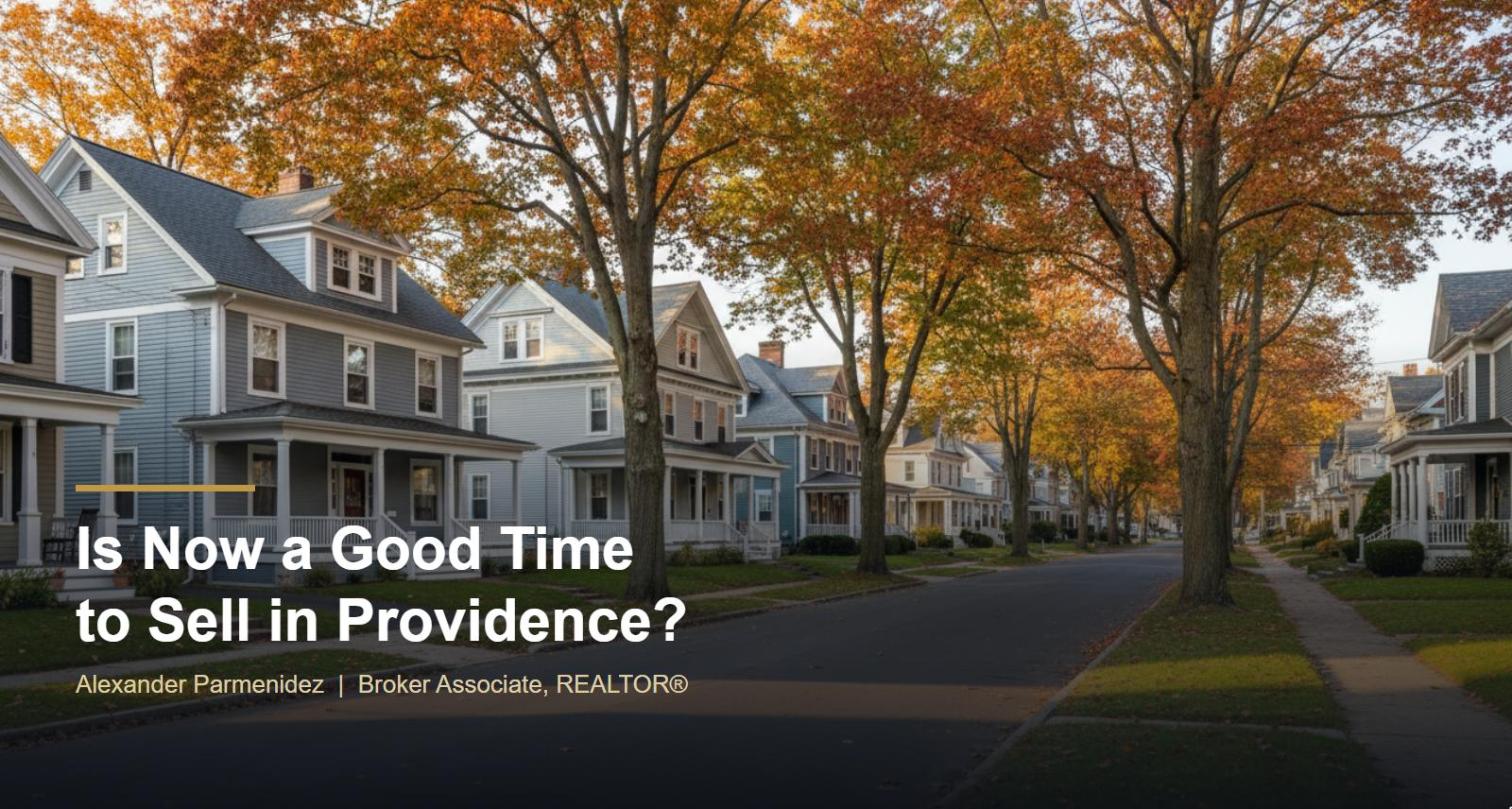
What the data actually says about Providence right now
Three sources carry the picture, and each one changes something for a seller.
Appreciation. The FHFA House Price Index for Q2 2026 shows the Providence-Warwick, RI-MA metro up 4.16% over the prior year, 1.08% for the quarter, and 43.07% over five years. Nationally, prices rose 2.1%. Providence ranked 20th out of the 100 largest metros for annual appreciation. This is the most authoritative number in the piece — FHFA tracks repeat sales of the same properties, so it is not distorted by which homes happened to trade this quarter.
Price and pace. Redfin’s data for the three months ending August 2026 puts the Providence median sale price at $581,365, up 7.7% from the same period last year. Homes went under agreement in a median of 25 days, two days slower than last year. The sale-to-list ratio was 101.3%, and 54.7% of homes sold above asking — up 9.5 points. There were 413 sales in August, down 4.8% from last August.
Supply. The Rhode Island Association of REALTORS® reported in its August 20 release that the statewide single-family median reached $525,000 in July, up $20,000 year over year, and that Rhode Island’s housing shortage remains at roughly half the supply that signals a healthy balance between buyers and sellers. Listings did increase from June to July — a break from last year’s pattern.
Put those together and the headline reads: fewer transactions, higher prices, more competition per transaction.
Why fewer sales does not mean falling prices
I walk clients through this every time the headlines feel contradictory. One article says sales are at a 15-year low. Another says homes are selling over asking. Both are true.
Sales volume measures how many people transacted. Price measures what the ones who did transacted at. When supply is as thin as it is here, a drop in the number of buyers does not push prices down, because the buyers still in the market have very little to choose from. Fewer transactions mostly means less competition from other sellers.
What this changes for you: do not read a sales-volume headline as a signal to wait. Read it as a signal that the buyers touring your home are serious ones.
Providence is not one market, and that matters more than the citywide number
This is the correction I would make to almost every market report you read, including the ones about my own city.
Condominiums, single-family homes and multifamily properties are different animals with different buyers and different math. Statewide in July, the single-family median was $525,000, the condo median $399,900 with sales down 10.3%, and the multifamily median $620,000 with sales up 15.1%. Those three lines are not one market moving together.
In my experience multifamily generally has the strongest appetite of the three. But even there, condition and the investment numbers decide it. If the rents do not carry the payment for an investor, the property can sit regardless of how short inventory is citywide. A shortage does not rescue a deal that does not pencil.
What this changes for you: the citywide median is background, not your price. What sets your number is your property type, your submarket, your condition, and what a buyer in your specific price range has to choose from this month.
The 25-day rule
Here is where my field experience and the data land in the same place from opposite directions.
Redfin’s median days on market for Providence is 25. The typical home goes pending in about 27 days. Separately, from what I watch on my own listings and my clients’ searches: once a property gets past roughly 25 days without the expected activity or an acceptable offer, buyers start treating it as a red flag. They begin asking themselves what is wrong with it. Is it overpriced? Why hasn’t somebody bought it?
The portal number and the psychology are describing the same threshold. Past about three and a half weeks, the market has told you something.
If it doesn’t compel, it doesn’t sell.
What this changes for you: build your pricing strategy around a three-week window, not a three-month one. Decide in advance what you will do if week four arrives quiet, so you are making that decision on a plan rather than on frustration.
When a price reduction actually resets a listing
Nearly one in five Providence listings — 19.4% — has taken a price cut. That is a large number in a market where more than half of sales close above asking, and it tells you how much of the market has been priced by hope.
Once a listing has gone stale, I do not believe a token $5,000 or $10,000 reduction necessarily resets anything. The buyers who passed at the old number are not sitting there waiting for a rounding error. If we are going to reposition a property, sometimes the adjustment has to be meaningful — potentially 5%, and depending on the circumstances, approaching 10%.
I want to be careful here, because this is absolutely property-specific. I would not present 5–10% as a universal rule. What is or is not meaningful depends on the price band, the property type, how far off the original number was, and what has come on the market since you listed. The principle is what matters: a reduction has to be large enough that a buyer who already passed has a reason to look again.
What this changes for you: price it right the first time and you likely never have this conversation. Price it aspirationally and the correction costs more than the premium you were reaching for.
Who is actually buying in Providence right now
I would not give you a universal number of groups per open house, because turnout varies substantially by property, price, location and condition. Anyone quoting you an average there is selling you a number, not information.
What I am seeing is a steadier, more deliberate buyer. When a property represents an opportunity and the numbers or the condition make sense, buyers are still there — four offers on average in Providence, per Redfin, and hot homes still going about 5% over list and pending in nine days.
One meaningful change from the frenzy of previous years: I am not seeing buyers routinely waive inspections. Recognizing an opportunity is not the same as giving up your protections, and buyers have stopped treating those as the same decision.
So rather than “there are fewer buyers, but every buyer is serious,” the accurate version is this: buyer activity is more selective. The right property, at the right price and in the right condition, can still generate strong interest. But buyers are looking more carefully at what they are getting for their money.
What this changes for you: plan on an inspection happening and on it being read closely. Knowing what it will surface before you list is worth more than hoping it gets skipped.
Preparation: bring the home up to speed, don’t renovate for the market
My first piece of advice to a seller is never “go spend $20,000 renovating your house.”
Most sellers have some level of deferred maintenance by the time they are ready to sell. That is normal. Many do not have the financial capacity — or the need — to complete major renovations. The goal is not to make the home new. The goal is to bring it up to speed for today’s buyer.
My priorities, in order:
- Decluttering. This matters whether I am listing a condo, a single-family or a multifamily. It is the highest-return hour you will spend and it costs nothing but time.
- Paint and basic cosmetic touch-ups where needed. Address the specific things that make a property immediately feel tired or poorly maintained.
- Presentation and photography. How the property presents online matters enormously, because for nearly every buyer that is the first interaction with your home. In a market where the decision window is 25 days, the photos are doing the first two weeks of work.
The bigger issue underneath all of it is deferred maintenance. Today’s buyer is already doing math on what it costs to purchase the property at all — at a 30-year fixed rate averaging 6.76% as of September 10, compared with 6.35% a year ago. If they walk through and immediately start mentally adding another large number for obvious repairs after closing, that changes how they perceive the value and what they are willing to offer.
I do not promise sellers a specific dollar-for-dollar return on paint, staging or repairs. That is not the point. The objective is to remove unnecessary objections.
I want the buyer thinking: I can buy this property, move in, and improve it over time. Not: I’m buying this property, and now I immediately need another major amount of money just to make it functional.
That distinction is worth more than any single renovation.
Your timeline has to match the market you’re entering
One seller experience from this summer illustrates this better than any statistic.
June, July and August felt slow in the field — particularly during what I call our beach season. I prepared that seller for the possibility that the property could take longer to sell, and explained that pricing would matter even more in a slower seasonal stretch.
The state data backs up what I was feeling. In its June release, RI REALTORS® reported that May’s statewide median of $500,000 was down 2.5% from a year earlier — the first annual decline since January 2017. By July the median had recovered to $525,000. That summer dip was real, and it was measurable.
That seller was not under pressure to sell immediately, which gave us room to work through the market rather than react to it emotionally. It did take longer than we would have liked. Eventually the right buyer came along and we put the deal together.
The lesson was not that the market was bad. It was that a seller’s timeline and expectations have to match the market they are actually entering. If you are not in a rush, you have flexibility. If you need to sell within a specific window, pricing and preparation stop being optional.
Should you wait for spring 2027?
The data does not support waiting as an obvious winning move.
Spring 2026 was softer than spring 2025. First-quarter single-family sales fell nearly 9% year over year, pending sales dropped 13.5%, and March was the slowest month for single-family sales since RI REALTORS® began monthly record-keeping in 2010. Then May’s median posted that first annual decline in nine years. Anyone telling you spring is automatically the better window is describing 2021, not 2026.
Meanwhile the current conditions are favorable: appreciation running at double the national rate, supply at roughly half of balanced, more than half of sales closing above asking, and well-prepared homes going under agreement in under four weeks.
None of that is guaranteed to be more favorable six months from now. Rates are higher than they were a year ago, not lower.
What this changes for you: the question is not whether fall or spring is better in the abstract. It is whether your home, at your price point, in your submarket, is ready to compete now.
Frequently asked questions
Is now a good time to sell a house in Providence, RI?
Yes, for a home that is priced and prepared correctly. The Providence-Warwick metro appreciated 4.16% over the year through Q2 2026, ranking 20th among the 100 largest U.S. metros, and 54.7% of Providence homes sold above list price over the three months ending August 2026. Supply remains at roughly half of a balanced market. The caveat is that 19.4% of listings took a price cut in the same period, so the advantage goes to sellers who price to the market rather than to a hoped-for number.
How fast are homes selling in Providence right now?
The median is 25 days on market, two days slower than a year ago, with the typical home going pending in about 27 days. In my experience, once a listing passes roughly 25 days without the expected activity, buyers start asking what is wrong with it. The full listing-to-closing timeline runs longer, commonly several weeks to a couple of months depending on financing, inspection outcomes and title work.
Are Providence homes still selling over asking price in 2026?
More often than a year ago. Redfin reports 54.7% of Providence homes sold above list over the three months ending August 2026, up 9.5 points year over year, with a sale-to-list ratio of 101.3% and an average of four offers per home. That premium is not automatic — it goes to homes that are priced accurately and presented well in the first two weeks on market.
How much of a price reduction does it take to reset a stale listing?
It is property-specific, and there is no universal rule. What I can tell you is that a token $5,000 or $10,000 cut does not necessarily reset anything, because the buyers who already passed are not waiting on a rounding error. A meaningful repositioning sometimes needs to be 5%, and depending on circumstances can approach 10%. The better strategy is pricing accurately at launch so the conversation never happens.
What should I do to prepare my Providence home before listing?
Declutter first, handle paint and basic cosmetic touch-ups, and invest in presentation and photography, because online is where nearly every buyer meets your home. The larger issue is deferred maintenance: buyers are already calculating what the purchase costs them, and visible repairs get added to that number in their heads. The goal is not to renovate for the market. It is to remove unnecessary objections so a buyer thinks about moving in and improving over time, rather than about what they have to fix immediately.
Your next three steps
- Get a written net-proceeds estimate before you decide on timing. Not an online estimate — a real one built from comparable sales in your submarket, your payoff, closing costs and taxes. The decision to sell this fall or next spring should be made against a number, not a feeling.
- Walk your own home like a buyer, with a notepad. Write down every item a buyer would mentally add a dollar figure to. That list, not a renovation budget, is your preparation plan.
- Set your 25-day decision in advance. Before you list, agree with your agent on what happens if week four arrives without an acceptable offer. Deciding that under pressure is how token reductions happen.
Call or text me anytime at 401-426-4857. English or Spanish, either is fine. If you want to know what your home is worth in this market and what a realistic timeline looks like, I will run the numbers with you.
For the statewide picture, including why mortgage rates rose this month, read my Rhode Island housing market brief for Q4.
Thinking about listing this fall? Send me your street and I will tell you what the last three sales on it actually did — and what that means for your number.
Check out this article next
Propiedad de inversión en Pawtucket, RI: lo que dicen los números de mayo de 2026
El mercado multifamiliar de Providence County está estable. La tasa publicada de 5.2% es un promedio nacional Clase A/B, no lo que buscan los compradores…
Read ArticleThinking about selling?
Know what you’d actually walk away with.
Alexander prepares a written net-proceeds estimate from live comparable sales, your payoff, closing costs and taxes, so you can decide on timing with real numbers. A 30-minute call, no obligation to list.
Schedule a net-proceeds callEnglish or Spanish · Call or text 401-426-4857 · Contact form
196 Waterman St, Providence, RI 02906 · C: (401) 426-4857 · O: (401) 351-2017 · [email protected] · alexparmenidez.realtor